The Government of Tajikistan has instructed relevant ministries to speed up the process of the establishment of production of electric vehicles inside the country.
It is also instructed to take necessary measures to promote electrification of the country’s public transportation and launch an infrastructure for electric transport.
According to government’s regulation posted on the Justice Ministry’s website for legal information, the Ministry of Industry and New Technologies and the Ministry of Transport undertake to fulfill these instructions before the end of this year.
Recall, the government adopted the program for development of electric transport in Tajikistan for 2023-2027 on October 31, 2022.
The program, in particular, provides for exempting the import of electric transport from payment of taxes and customs duties. It also provides for creating a wide necessary infrastructure in the country, including electric vehicle charging points. The program also says the electric transport market in the country is still at the stage of formation and its development is assessed as weak.
The program authors note that the main reasons for the underdevelopment of the country’s electric transport market are high cost of electric vehicles, lack of charging and maintenance stations, and lack of stimulus measures.
The estimated budget for implementation of the electric transport development program is about230 million somonis (equivalent to 21 million US dollars), including 1.4 million somonis of budgetary funds, 6.2 million somonis of development partners funds and more than 221 million somonis of the private sector.
In his address to a joint meeting of both chambers of the parliament, President Emomali Rahmon noted on December 23, 2022 that the use of “clean" energy generated in our country for charging electric vehicles, will reduce demand in oil products, and thereby contribute to the protection and improvement of the environment. “In this context, the Ministries of Industry and New Technologies and Transport are mandated to take specific measures to initiate the manufacturing and assembly of electric vehicles within the country,” Rahmon said.
In December 2021, President Emomali Rahmon proposed to completely waive taxes and customs duties on imports of electric vehicles — electric cars, electric buses, trolleybuses, etc.
He instructed the government to take measures to provide infrastructure and other necessary conditions for the use of such vehicles in the country.
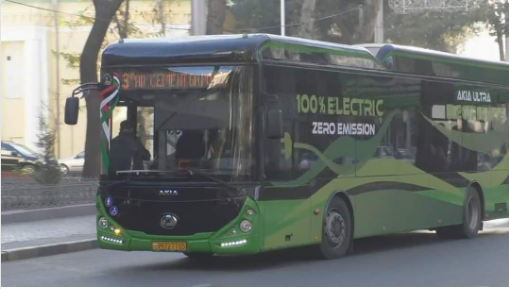
An electric bus, assembled at the Dushanbe-based Akia Avesto plant, appeared on the streets of Tajik capital in early December that year. This electric bus reportedly can easily travel up to 200 kilometers on a single charge.
A Dushanbe-based taxi company, Yak Tax, has launched a new category on it app through which customers can book an electric vehicle for their rides. A number of electric cabs appeared on the streets of Dushanbe in 2022. Unlike the usual yellow cabs, Yak Taxi’s electric cabs are painted green.
CABAR.asia says Tajiks who already own an electric car say their use is inexpensive, safe, and environmentally friendly, so the government should encourage the import of electric cars.
Currently, owners of electric cars charge their cars at home and they pay for electricity as residential customers – 26.51 dirams per 1 kWh of electricity.
The price of the cars they imported reportedly ranged from US$20,000 to US$30,000, and the electricity consumption depends on the speed of the vehicle. Electric cars are typical in the city because of low landings and have rarely been used on regional roads.
According to experts, gradually filling the country with electric cars could reduce air pollution.
The gradual increase in electricity generation in Tajikistan reportedly allows increasing the number of electricity-powered vehicles in Tajikistan. Tajik officials say this will reduce the country's dependence on oil-exporting countries.
Tajikistan endowed with rich hydropower resources, hydro potential is estimated to be 527 billion kWh per year. In technical terms, the waterpower resources of Tajikistan have good prospects for the development and consist of 317 billion kWh per year. According to the Ministry of Energy and Water Resources of Tajikistan, from 2015 to 2020, the total capacity of the country’s power plants increased from 1,100 to 6,000 MW. It is expected to reach 10,000 MW by 2030.
An electric car or battery electric car is an automobile that is propelled by one or more electric motors, using energy stored in batteries. Compared to internal combustion engine (ICE) vehicles, electric cars are quieter, have no exhaust emissions, and lower emissions overall.