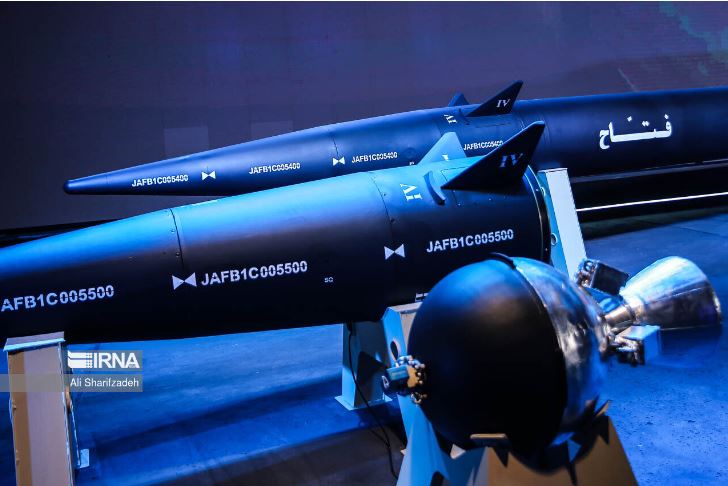
Iran has unveiled its first-ever hypersonic missile, which it says can penetrate missile defense systems and will give it a military edge. Iranian state-run media yesterday published images of an unveiling ceremony, attended by President Ebrahim Raisi and senior commanders of the Islamic Revolutionary Guard Corps (IRGC), with the domestically made black missile visible.
IRNA yesterday evening cited a lawmaker of the Iranian parliament as saying that Iran’s unveiling of its home-made hypersonic ballistic missile – called “Fattah” meaning “conqueror” in Farsi – is a sign of that Iran's power is endogenous and comes from its people.
Abbas Moqtadaei, a deputy head of the Iranian Parliament (Majlis) National Security and Foreign Policy Committee, told IRNA correspondent on June 6 that by building Fattah, Iran demonstrated that any party seeking to threaten the country will be badly punished.
The countries that once sought to “cripple” the Islamic Republic of Iran are now witnessing the growth of the country in the field of defense, the lawmaker said.
During a ceremony participated by President Ebrahim Raisi earlier in the day, Iran unveiled its new hypersonic ballistic missile.
The Fattah missile reportedly has a range of up to 1,400 kilometers and is capable of travelling at 15,000 km/h of speed.
Al Jazeera says IRGC aerospace chief Amir Ali Hajizadeh announced news of the development of the hypersonic missile last November at an event marking the anniversary of the death of Hassan Tehrani Moghaddam, known as the father of Iranian missile technology.
Hypersonic missiles move at five times the speed of sound or greater and are maneuverable, making them difficult for defense systems and radars to target.
The United States, Russia, China and North Korea are believed to be the only countries to have successfully tested hypersonic missiles, but exact details of the weaponry remain scant.
Meanwhile, Reuters reports that Western military analysts say Iran sometimes exaggerates its missile capabilities.
Concerns about Iran's ballistic missiles contributed to then-US president Donald Trump's decision in 2018 to ditch Tehran's 2015 nuclear pact with six major powers.
Trump re-imposed US sanctions on Iran after exiting the nuclear pact, leading Tehran to resume previously banned nuclear work and reviving US, European and Israeli fears that Iran may seek an atomic bomb.
Iran has consistently denied any such ambition.