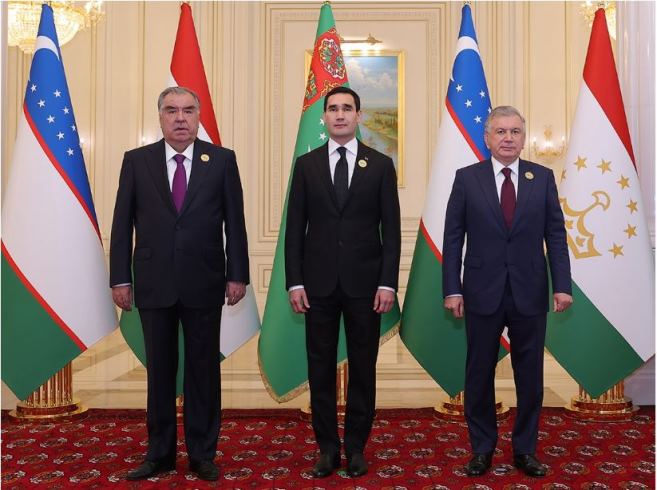
The leaders of Tajikistan, Turkmenistan and Uzbekistan held a tripartite summit in Ashgabat on August 4 with little advance warning and no of the governments has provided explicit explanations on why these three partners would be forming a united front in this format. The highlights of the joint declaration offered some clues, though, according to Eurasianet.
First, there was the matter of water. All three countries border Afghanistan and reportedly stand to suffer immediate repercussions from ongoing work there on construction of the Qosh Tepa Canal.
Without explicitly mentioning Afghanistan, the joint declaration reflects strong shared anxieties about Qosh Tepa.
Another strand of the Ashgabat summit focused on the prospect of cooperation in the natural gas and electricity sectors.
The plan is to hold three-way talks between the managers of those industries – presumably at a ministerial level – later this year to consider opportunities for collective action.
Eurasianet says that on the gas front, attention may turn to the long-delayed project to build a fourth strand of the Central Asia-China pipeline. When and if it is finished, Line D would carry 30 billion cubic meters of the Turkmen fuel to Chinese buyers.
Recall, Tajikistan will be a transit country for Turkmen natural gas to China. The Central Asia–China gas pipeline (known also as Turkmenistan–China gas pipeline) is a natural gas pipeline from Central Asia to China’s northeast Xinjiang-Uyghur Autonomous Region (XUAR).
A total length of Line D (a gas pipeline from Turkmenistan to China through Tajik territory) is 966 kilometers. The gas pipeline will run through territories of Turkmenistan, Uzbekistan (205 km), Tajikistan (391 km), Kyrgyzstan (215 km) and China (155 km).
Eurasianet notes that if this China-centered project is indeed top of the agenda, though, it is a problem that the president of Kyrgyzstan, which would also lie along the route of Line D, was not present at the summit. Relations between Kyrgyzstan and Tajikistan are currently in the gutter because of a border dispute that has repeatedly turned deadly.
A press release issued by Turkmenistan’s Foreign Ministry opted to make its gas export focus somewhat tighter, stating only that Ashgabat’s unconditional priority would be the supply of Turkmen natural gas to the nearest neighbors: Uzbekistan and Tajikistan.