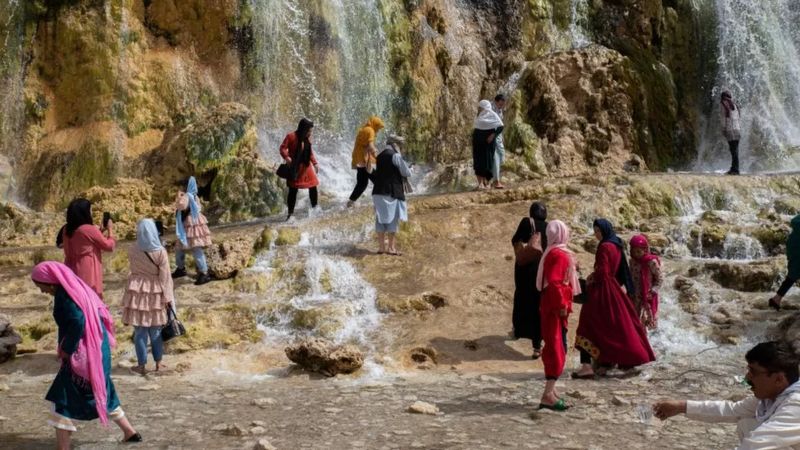
The Taliban banned women from visiting the Bande-Amir National Park in the central province of Bamian, writes BBC.
The acting Minister of Virtue and Vice of Afghanistan, Mohammad Khaled Hanafi, said that women do not follow the rules of wearing hijab in the park.
He called on religious clerics and security services to ban women from entering the park until a solution to the problem is found.
In 2009, Bande-Amir became the first National Park in Afghanistan and as such turned into a popular tourist center and a place for family holidays.
UNESCO documents describe the park as "a group of lakes created by nature with special geological formations and structure, as well as unique natural beauty."
However, according to the Afghan Tolo News agency, quoting Hanafi, visiting the park for the purpose of sightseeing "is not mandatory."
Religious clerics in Bamiyan said that women who visit the park and do not follow the rules are not local residents.
"There are complaints about the lack of a hijab or a bad hijab, but these are not residents of Bamiyan. They come here from other places," Syed Nasrullah Vaezi, head of the Bamiyan Shiite Ulama Council, told Tolo News.
Former member of the Parliament of Afghanistan Mariam Solaimanhil posted a poem on the X website (former Twitter) about the ban, and wrote: "We'll be back, I'm sure of it."
Human Rights Watch spokeswoman Fereshta Abbasi noted that the ban coincided with Women's Equality Day (celebrated in the United States on August 26 on the anniversary of the adoption of the 19th Amendment to the Constitution, which prohibited discrimination on the basis of sex), and said that it was "complete disrespect for the women of Afghanistan."
Richard Bennett, the UN Special Rapporteur on Human rights in Afghanistan, asked why the ban on women visiting Bande-Amir "is necessary to comply with Sharia law and Afghan culture."
The Taliban have repeatedly imposed bans on various actions for women, in particular, in December 2022, they were banned from attending schools.
Recently, the Taliban ordered the closure of hairdressers and beauty salons in Afghanistan, and in mid-July banned women from taking entrance exams to national universities.