Prices for gold bars produced by the National Bank of Tajikistan (NBT) are rising.
An official source within Tajikistan’s financial regulator says the price hike has been caused by increasing international gold prices.
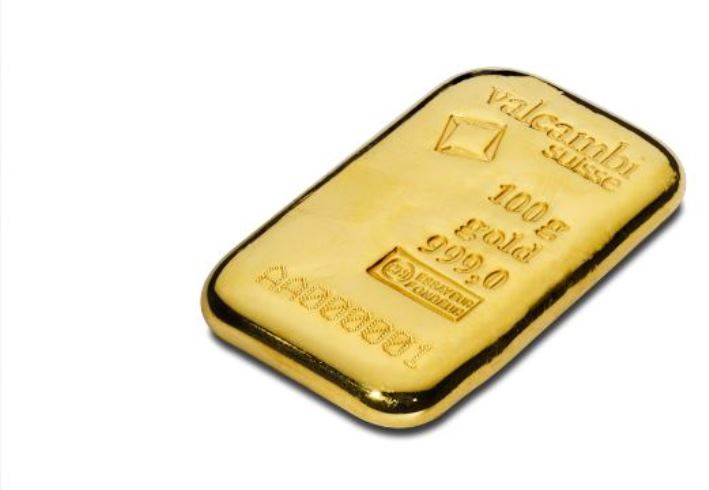
The National Bank of Tajikistan offers for sale gold bars weighing 5, 10, 20, 50 and 100 grams.
The 5-, 10-, 20-, 50- and 100 gram gold bars produced by the National Bank of Tajikistan were released into free circulation in June 2017.
The gold bars are sold by the NBT Department of Monetary Circulation and Cash Operations.
The NBT notes that as of December 12, 2023 the ask price for the 5-gram gold bar is 3,686.16 somonis (increased by 233.12 somonis compared to October 11, 2023), 10-gram gold bar – 7,106.84 somonis (increased by 322.66 somonis compared to October 11, 2023), 20-gram gold bar – 14,080.22 somonis (increased by 648.02 somonis compared to October 11, 2023), 50-gram gold bar – 34,971.19 (increased by 1,621.49 somonis compared to October 11, 2023), and 100-gram gold bar – 71,233.60 somonis (increased by 4,622.34 somonis compared to October 11, 2023).
The then-head of the NBT Jamshed Nourmahmadzoda told reporters in Dushanbe on February 5, 2020 that gold bars with a total weight of 100 kilograms are waiting for their customers in storage of Tajik central bank.
“By president’s order we have produced gold bars with a total weight of 100 kilograms and we are gradually selling them,” Nourmahmadzoda noted.
According to him, citizens of the country can buy the NBT-produced bars using their passports. “No other documents are required,” Nourmahmadzoda said.
Each citizen of Tajikistan can buy gold bars totally weighing one kilogram per year.
Recall, media reports said on December 4 that that gold prices notched a new record for a second day in a row. CNBC reported on December 3 that spot gold prices rose to a new record high of US$2,110.8 per ounce. On December4, it was trading at US$2,084.59.
Citing geopolitical uncertainty, a likely weaker US dollar and possible interest rate cuts, analysts noted in early December that gold prices are on course to hit fresh highs next year and could remain above US$2,000 levels.
Gold prices have reportedly risen for two consecutive months with the Israel-Palestinian conflict boosting demand for the safe-haven asset, while expectations of interest rate cuts have provided further support.
According to CNBC, gold tends to perform well during periods of economic and geopolitical uncertainty due to its status as a reliable store of value.
On December 1, gold reportedly touched US$2,075.09 to surpass a precious intraday record high of $2,072.5 on August 7, 2020, according to LSEG data.
According to a recent survey by the World Gold Council, 24% of all central banks intend to increase their gold reserves in the next 12 months, as they increasingly grow pessimistic about the U.S. dollar as a reserve asset.
Bullion reportedly has rallied almost 16% by early December since early October, a surge that was initially sparked at the start of the Israel-Hamas conflict, but has since been driven by bets on the Federal Reserve will shift to monetary loosening early next year.
Meanwhile, KITCO (Kerala Industrial and Technical Consultancy Organization) reports that as of December 12, 2023, the bid price for one ounce of gold was US$1,985.10 and the ask price was US$1,986.10.
The bid price refers to the highest price a buyer will pay for a security. The ask price refers to the lowest price a seller will accept for a security. The difference between these two prices is known as the spread; the smaller the spread, the greater the liquidity of the given security.