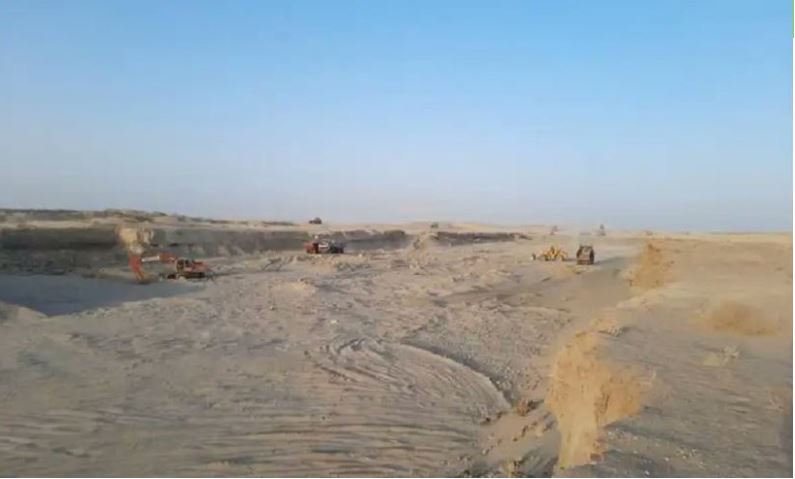
It seems the Qosh Tepa Canal project has failed as environmentalists from the Rivers Without Borders coalition have reportedly uncovered signs of a serious accident at the Qosh Tepa irrigation canal being constructed by the Taliban in northern Afghanistan.
Issued on December 12, the Rivers without Border’s press release notes that space images taken by the European Sentinel-2 satellite show that in the very first month after the canal began to be filled with water from the Amu Darya River, the walls of the hydraulic structure apparently could not withstand the pressure of the water flow, and a huge volume of water, escaping from the canal, spread throughout the entire nearby territory, forming a 9km lake in the desert due to a leak from hydraulic failure. The Taliban were reportedly warned of leaks by Uzbekistan three months ago but ignored them. They have also ignored calls to fix it; the lake is still getting bigger.
Meanwhile, Fergana news agency reported on December 15 that the Agency for Space Research and Technology under the Ministry of Finance of Uzbekistan has denied the information about the accident at the canal as baseless. According to Uzbek specialists, flooding of the nearby area was caused by groundwater.
The Diplomat notes that the Qosh Tepa Canal project invokes the legacy of Afghanistan’s first president, Mohammad Daud. Renowned for his progressive policies, notably agriculture plans and various economic modernization endeavors, Daud crafted the Qosh Tepa canal project shortly after assuming power through a bloodless coup, marking the end of the monarchy and propelling him to become Afghanistan’s first president in 1973.
The Qosh Tepa canal aimed to annually extract 10 billion cubic meters of water from the Amu Darya River. The Amu Darya, historically known as the Oxus, stands as Central Asia’s longest river, carrying 80 percent of the region’s water resources. It originates in Afghanistan’s Hindu Kush and Wakhan in the Pamir Highlands, delineating much of Afghanistan’s common border with its northern neighboring countries – Tajikistan, Uzbekistan, and Turkmenistan.
Afghanistan was reportedly granted an annual allocation of 9 cubic kilometers from the Amu Darya through an agreement with the former Soviet Union, an agreement that remains binding to this day. However, in practical terms, the country couldn’t utilize a third of its allocation.
Jump ahead 36 years, and the ambitious $684 million Qosh Tepa canal project, currently led by the Afghanistan National Construction Company, has sparked alarm among Afghanistan’s northern neighbors. Central Asian concerns about the dwindling water resources in the Amu Darya are valid, yet Afghanistan borders the river too and has long been deprived of the right and opportunity to utilize its bounty.
Tajikistan is not directly impacted by the canal project, but has apprehensions regarding initiatives that would foster stability for the Taliban regime in Afghanistan.
The canal project holds economic significance for Uzbekistan, which uses the Amu Darya’s waters to irrigate 2.3 million hectares of land, and Turkmenistan, which irrigates 1.7 million hectares with its water. The two reportedly could suffer a loss of up to 15 percent of the current water flow from the Amu Darya into their territories because of the canal project. As such, both nations harbor deep concerns about the implications of reduced water flow, especially regarding their highly lucrative cotton fields.
Recall, Afghanistan’s media reports said in mid-October that following the completion of the work of the first phase of the Qosh Tepa Canal, the Taliban-run government in Kabul on October 11 started work on the second phase of the Qosh Tepa Canal, which has been billed by Afghan officials as a way for Afghanistan to ensure its own farming needs.