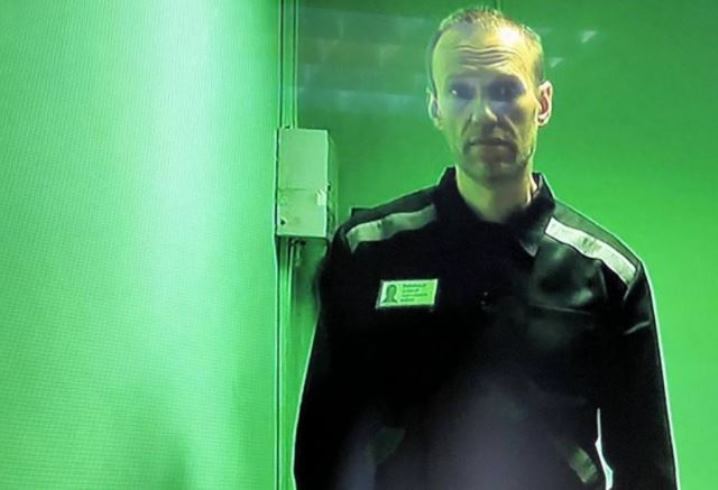
Eurasianet says Russian opposition leader Alexei Navalny was not always well-regarded in Central Asia, because of his history of ill-judged remarks about people from the region. His death has nevertheless been greeted there with shock and dismay, if also much indifference.
According to Eurasianet, the news of his death on February 16 at the IK-3 prison colony in Kharp, a settlement in the far north of Siberia, dominated the headlines of many privately run outlets.
State media, however, mostly avoided the topic. An exception was Kyrgyzstan’s Kabar news agency, which reproduced a dry bulletin from Russia’s state-run TASS news agency.
Mourners in Almaty, Kazakhstan’s business capital, a city to which thousands of Russians have decamped to avoid being called up for military duty, reportedly left flowers at the gates of the Russian consulate. The same scene played out at the Russian Embassy in Tashkent, Uzbekistan. A photo posted on Telegram showed how somebody had placed a single red rose at the base of a monument to victims of political repression in Pavlodar, a city in northern Kazakhstan.
The intensity of the public conversation around Navalny has differed across the region. In the very relative openness of Kazakhstan, those with views shared them online. In the suffocated environment of Tajikistan, the idea of showing sympathy to anti-system figure appears to have discouraged similar conversations, according to Eurasianet.
Opinions on the activist are also invariably strongly correlated with exposure to Russian state media. Where Kremlin talking points get more of an airing, views are accordingly conditioned.
Navalny’s standing in Central Asia was complicated by other factors. Remarks he made to journalists in the past betrayed a readiness to dabble in xenophobic rhetoric. That point was made to Global Voices by Sergei Abashin, a professor at the European University at Saint Petersburg, in a 2021 interview.
“Ten years ago, Navalny took part in the annual ‘Russian Marches’ that were openly xenophobic,” Abashin said. “During the Moscow mayoral elections of 2013, one of Navalny’s main talking points in his public appearances was the topic of migration, something he proposed to fight, using in his rhetoric a flurry of xenophobic attacks against people from Central Asia and the Caucasus, accusing them of being criminals, posing a terrorist threat and being alien to Russian culture.”
One episode that caused much upset in Uzbekistan occurred in 2017, when Navalny said dismissively of Uzbeks that it was unlikely that many of them had heard of the famous Russian poet Alexander Pushkin.
In a later interview, from 2020, he apologized for those remarks, admitting that he had spoken out of turn.