Over the past few years, some high-ranking Tajik officials have again spoken about the need to abolish the moratorium and return the death penalty for a number of serious crimes.
CABAR.asia reports that the Prosecutor-General of Tajikistan, Yusuf Rahmon, once again stated at a news conference in Dushanbe on August 15 last year that the death penalty should be applied as punishment for certain types of crimes.
“I stand firmly on my position. I am in favor of applying the death penalty to incorrigible criminals; to criminals who have committed two or three murders; to terrorists who have committed serious crimes damaging the reputation of the state and the nation, and to other grave crimes,” Yusuf Rahmon said.
On August 4, 2016, during a news conference, answering a journalist’s question about the possible abolition of the moratorium on the death penalty, the Prosecutor General also stated that he “has a positive opinion about the introduction of the death penalty in Tajikistan.”
Yusuf Rahmon is not the only Tajik official who supports the death penalty for serious crimes. Before him, Tajik Interior Minister Ramazon Rahimzoda said he was “against the abolition of the death penalty.” At the time, he said, “sometimes serious crimes are committed that cannot be forgiven.”
The moratorium was introduced on July 15, 2004, when the parliament passed the Law on Suspension of the Death Penalty. This type of punishment is not used in Tajikistan and is now replaced in most cases by long or life sentences.
Until 2003, the death penalty in Tajikistan had been applied under fifteen articles of the Criminal Code. Then the articles under which the death penalty was applied were reduced to five. These are Article 104 (murder), Article 399 (biocide – use of nuclear, neutron, chemical, biological (bacteriological), climatic or other weapons of mass destruction), Article 398 (genocide), Article 179 (terrorism), Article 138 (rape).
The death penalty in the form of firing squad shall be established as an exceptional measure only for the following crimes: murder (part two of Article 104), rape (part three of Article 138), terrorism (part three of Article 179), genocide (Article 398), biocide (Article 399).
Until 2004, Tajikistan ranked first among OSCE member states in terms of the number of death sentences (based on population). These findings are based on unofficial information, as official information remains confidential.
According to the monitoring report of the public organization “Bureau for Human Rights and Rule of Law” conducted in 2004, 133 death sentences were carried out in Tajikistan between 2001 and 2003. Most of them were carried out in 2001 – 68 death sentences.
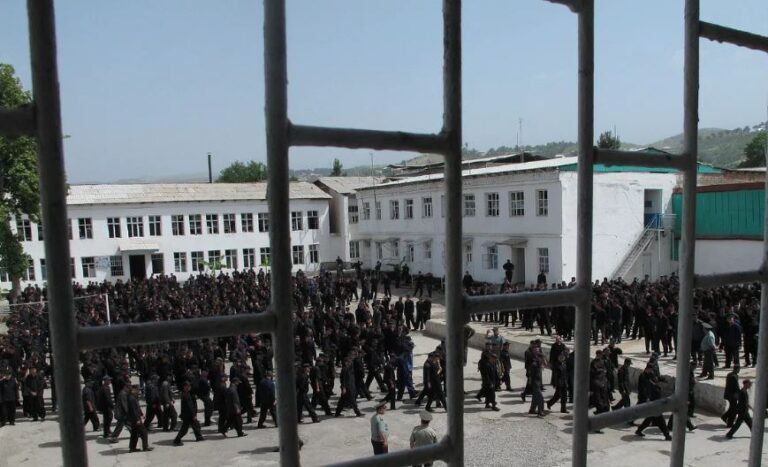
For women, adolescents and the elderly, the death penalty was completely abolished in 2004 and today courts in Tajikistan apply life imprisonment, which replaced the death penalty.
Tajikistan’s moratorium on the death penalty was introduced when the country was just emerging from a long civil war and the judicial system was in crisis. There was a high likelihood of errors in investigation and sentencing that would lead to the death of an innocent person.
But even almost 20 years after the moratorium was declared, experts still insist on its preservation due to the imperfection of the investigative and judicial bodies, their dependence on the executive branch and the lack of guarantees of full justice during sentencing.
Oinihol Bobonazarova, a Tajik human rights activist and lawyer, emphasizes the importance of the independence of the investigative and judicial systems and says the moratorium on the death penalty should be maintained.
“Both the investigative and judicial systems are not independent [in Tajikistan], they depend on the executive branch. This causes a lot of errors in sentencing,” Bobonazarova said.
Given the imperfection of the country’s investigative and judicial system and the possibility of errors in sentencing, experts negatively assess the consequences of lifting the moratorium on the death penalty in Tajikistan.
Shokirjon Hakimov, a doctor of law and deputy chairman of the Social Democratic Party of Tajikistan, said lifting the moratorium on the death penalty would make it impossible to review a case and impose a fair sentence.
The courts do not ensure equal rights for participants in court proceedings, which also reduces the likelihood of a fair verdict, he said. There is also a low level of knowledge of authorized investigative officers and judges, lack of transparency, imperfect personnel policy, corruption and other undesirable phenomena.
Although life imprisonment has a negative impact on a person’s mental and psychological state, he said, it still allows in exceptional cases and when new evidence is discovered to reconsider a case and pass a fair sentence.
Most experts believe that the return of the death penalty will not reduce crime and will not prevent serious crimes.
It is worth noting that although Tajikistan has adopted and ratified the Universal Declaration of Human Rights and the International Covenant on Civil and Political Rights, on the basis of which it declared a moratorium on the death penalty, the country has not yet signed the Second Optional Protocol to the International Covenant on Civil and Political Rights. The aim of that instrument was the total abolition of the death penalty.
More than 50 countries in the world have the death penalty. Such countries as the United States and Japan have not abandoned capital punishment, and the death penalty is also applied there. Among Tajikistan’s neighbors, the death penalty is applied only in China and Afghanistan.