The five main river basins in Central Asia are formed by the Amu Darya, Syr Darya, Balkhash-Alakol, Ob-Irtysh, and Ural rivers.
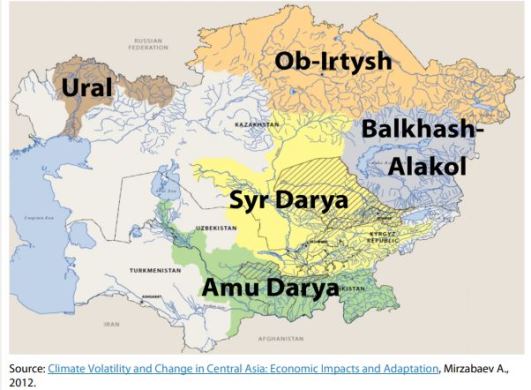
Between them, the Amu Darya and Syr Darya river basins provide 90% of the region's river water and cover 37 % of the land area of ex-Soviet Central Asia, including most of Kyrgyzstan, Tajikistan and Uzbekistan, as well as large parts of Turkmenistan and Kazakhstan and some parts of northern Afghanistan are also within the Amu Darya basin. The Amu Darya and Syr Darya rivers are home to nearly 80% of Central Asia's population.
Central Asian countries are major agricultural producers, including of water-intensive crops such as cotton, but with little water coming from rainfall they rely on irrigation. Between them, the five countries have a total irrigated area of some 100 000 km2, requiring huge amounts of river water. Due to the massive amounts of water used for irrigation, agriculture is by far the biggest water user in Central Asia, and per capita water use in Central Asia is much higher than in European countries.
Energy resources are shared unevenly between the five Central Asian countries. Kazakhstan, Turkmenistan and Uzbekistan have abundant fossil fuel reserves, enabling them to meet domestic energy needs and earn money from exports. By contrast, Kyrgyzstan and Tajikistan have very little oil and gas of their own; unable to benefit from hydrocarbon exports, they remain impoverished, and depend on energy imports from their neighbors. On the other hand, they have plenty of mountains and water, and therefore strong hydropower potential. At present, Kyrgyzstan uses just 10% of that potential, while for Tajikistan, that figure falls to 6.0%; even so, both countries already produce over 90% of their electricity from hydropower.
Central Asia’s countries now annually uses for irrigation more than 60 billion cubic meters of water of the Amu Darya and Syr Darya river, which is 6 times more than the design capacity of the reservoir powering the Nurek hydropower plant.
However, approximately 70-80% of the water intake limit has actually been used in recent years.
The fact is that transboundary rivers can no longer provide the desired volume of water due to a decrease in their influx.
During the growing season (summer), about 56 billion cubic meters of water of the Amu Darya are withdrawn for irrigation. Of them, 15.7 billion cubic meters of water are used during the inter-vegetation period.
A total volume of the limit of water intake from the Syr Darya during the inter-vegetation period in 2023-2024 is 4.24 billion cubic meters.
The Central Asian nations will once again clarify the water intake limits and make appropriate adjustments, taking into account the current water situation, at the 86th session of the Interstate Commission for Water Coordination (ICWC) that will take place in Kazakhstan within the next few months.
It all depends on how much water flows into transboundary rivers.
Last year, a total volume of intake of water from the Amu Darya and Syr Darya rivers was approved at 51.5726 billion cubic meters, including 39.6776 cubic meters from the Amu Darya River and 11.895 billion cubic meters from the Syr Darya River.
But actually, the Central Asian nations last year used 42.9971 billion cubic meters of water, or 83.37 percent of the limit. The volume of water intake in the Amu Darya River was 33.2 billion cubic meters, and in the Syr Darya River, it was 9.807 billion cubic meters.
Last year, actual water content in the Amu Darya basin during the vegetation period was 93.1 percent of the norm. In April-May, it was within 68-86% of the norm, and beginning from the second half of June it rose to 115 percent of the norm.
This allowed the planned volume of water to be accumulated in reservoirs by the end of the season, but it had a negative impact on the supply of water to downstream countries at the beginning of the growing season.
In the second half of February, the flow of the Amu Darya River amounted to 722 million cubic meters, which is 50 million cubic meters less than forecast. The inflow into the Nurek reservoir was 24 cubic meters less than forecast, the release of water from the reservoir decreased accordingly.
During this period, the volume of water in the reservoir powering the Nurek hydropower plant was 7.1 billion cubic meters, which is more than 3 billion cubic meters less than the volume that this reservoir can hold.