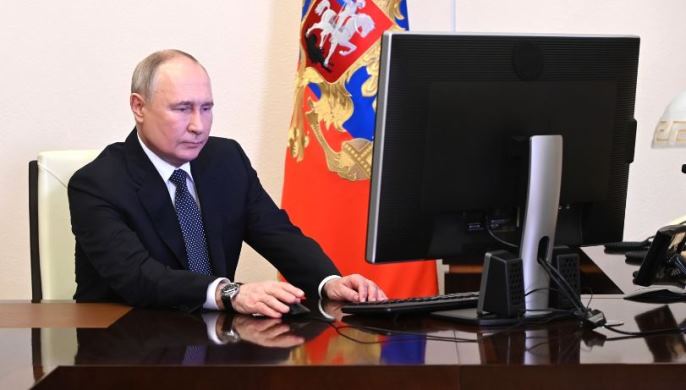
Eurasianet says Russian President Vladimir Putin has suffered a crushing election defeat in Almaty, Kazakhstan’s business capital.
Elsewhere in Central Asia, where many thousands of Russian citizenship-holders cast their ballot in the presidential elections over the weekend, he performed far more strongly.
An independent exit poll conducted in Almaty surveyed around 1,600 people at a polling station in the consulate and reportedly found that only 8 percent declared they had voted for Putin.
Vladislav Davankov, a foil candidate nominated by the New People party, garnered around 70 percent of the votes, the exit poll found.
Large numbers of Russians have relocated to Kazakhstan to either evade being drafted into the army or as a gesture of their rejection of Putin’s rule.
Kyrgyzstan likewise has drawn many such people – known collectively by the term relokanty – but there was little sign of anti-Putin dissent there.
Of the more than 7,800 people that cast their ballot, around 81 percent voted for the Russian leader. That was a little short of the 87.3 percent that Putin registered across the board.
In Tajikistan, which hosts a Russian military base, more than 9,500 people voted, according to Eurasianet.
One section of the voters there were Tajiks with dual citizenship. Although such things are hard to gauge in the absence of polling data, it appears pro-Putin sentiments are typically strong in Tajikistan.
In Uzbekistan, around 4,600 Russian nationals reportedly voted at polling stations in Tashkent and Samarkand. Reporters on the ground said they saw long lines, although it appears they too were mainly there to register their backing for Putin. The president’s victory there appears to have been less than wholly overwhelming, though. Putin reportedly got 57.6 percent of the vote against Davankov’s 31.9 percent.
Uzbekistan, like Kazakhstan and Kyrgyzstan, also attracted a certain number of relokanty.
Eurasianet notes that if the stance of Russian diasporas to the election was ambivalent, the same could not be said of Central Asian presidents.
Tajik President Emomali Rahmon was the first to congratulate Putin. “The result is more clear evidence of your lofty political standing and Russian society’s broad support for government policies aimed at ensuring stable social and economic development … and the strengthening the country’s international position,” Rahmon said.
Similarly fulsome compliments reportedly arrived from Uzbek President Shavkat Mirziyoyev and Kyrgyz President Sadyr Japarov.
Kazakh President Kassym-Jomart Tokayev described the election as a demonstration of the volume of “popular support for Russian leader’s strategic agenda.”