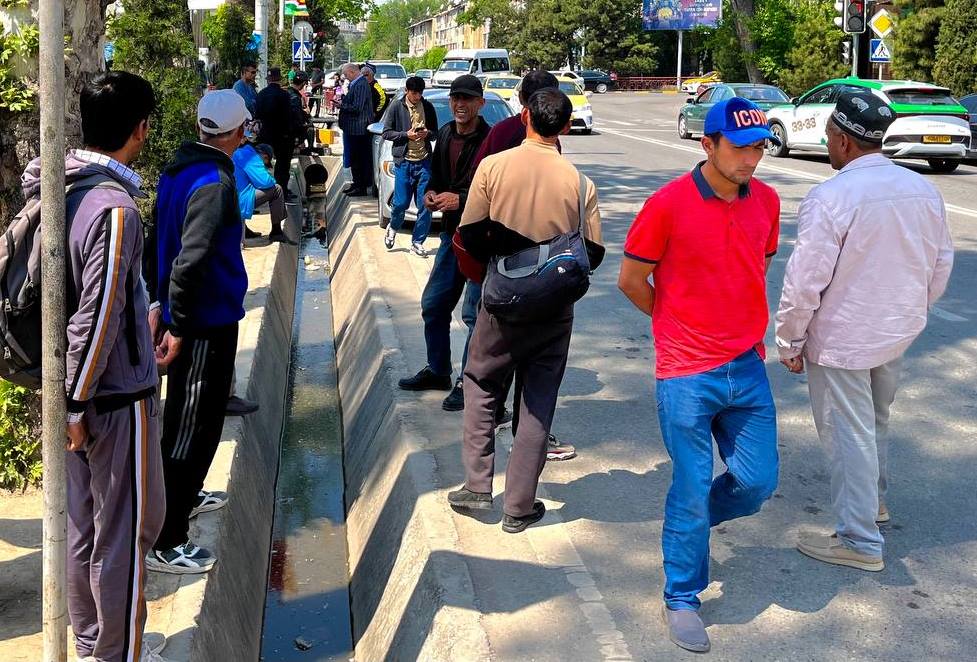
The sidewalk in front of the building of the Ministry of Education and Science is a place of spontaneous day labor market.
A group of men are sitting in a semicircle on the grass – they are mardikor (casual hired laborers) from nearby districts, who arrived in Dushanbe to look for work.
While waiting for “buyers”, they are talking on different topics, mainly about how difficult it is to survive in the new conditions and what is the situation in Russia.
Among them there are their own “political observers”, who frighten those sitting by talking about how hard it will be for the Tajiks after the Krasnogorsk terrorist attack.
“Better to wait until things calm down, and then you can go to work,” they advise.
But most of those sitting no longer connect their fate with migration. “At the very least, we can earn money here too,” they say.
Most of them are over forty years old and each of them has various working professions: builder; plumber; welder; tiler; plasterer; painter; and others.
Many of them work on piecework basis. They are promised to be paid after completing a certain amount of work such as plastering, screeding, pouring concrete.
Plasterers, for example, are ready to work at the rate of 30 somonis per one square meter.
There is also another work: cleaning; rubble removal; digging up a garden. They get paid per day – ranging 80.00 to 200.00 somonis, depending on the complexity of the work.
The casual hired laborers’ work is always a risk. No one enters into an employment contract with them; everything is decided verbally. Sometimes it happens that the customer, after completing the work, pays less than he promised. And here they can’t complain to anyone.
Usually customers are intermediaries, trusted representatives of moneybags, after all, an authoritative and money person himself will not go looking for a laborer. He entrusts this to his associates or hires some kind of intermediary. These intermediaries usually take more from the owner, and give the laborers less repayment.
It is to be noted that none of those, with whom the Asia-Plus reporters managed to talk, even tried to get a permanent job in Tajikistan.
“We read job advertisements and visited the Labor Ministry’s vacancy fairs, but everywhere they pay less and demand more,” they say.
The vicissitudes of life of the mardikor community are such that their children are often kept out of the education system. Unable to get decent schooling and qualifications, they too are likely locked into a cycle of basic subsistence.