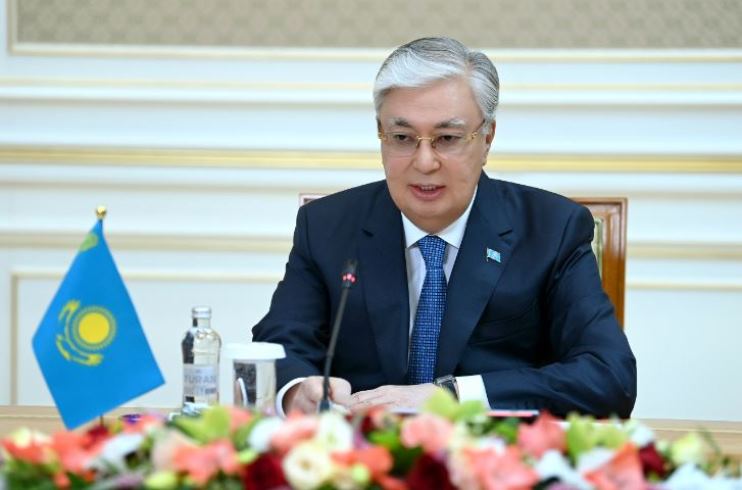
The decision was announced back in December, but recently Kazakh President Kassym-Jomart Tokayev remarked that it was made with “the understanding that this regime is a long-term factor.”
In late December 2023, when Kazakhstan removed the Taliban from its list of banned organizations, a Ministry of Foreign Affairs representative explained the decision to Kazinform as being in line with UN practices.
In a June 3 meeting with parliament speakers from the Collective Security Treaty Organization (CSTO) in Almaty, Kazakh President Kassym-Jomart Tokayev explained this decision in more detail.
Akorda, Kazakh president’s official website, says Tokayev noted that “Kazakhstan removed the Taliban regime from the terrorist list, based on the importance of developing trade and economic cooperation with modern Afghanistan and the understanding that this regime is a long-term factor.”
According to the Kazakh leader, an active involvement of Afghanistan in interregional relations is one of the strategic tasks at the present stage.
Noting the importance of a coordinated position of CSTO member nations on this issue, Kazakh president called for supporting Kazakhstan’s initiative to establish the UN Regional Center on Sustainable Development Goals for Central Asia and Afghanistan in Almaty.
The Diplomat notes that more than 100 individuals associated with the Taliban – from deceased leaders like Mullah Omar to current ministers like Mullah Abdul Latif Mansour (previously Agriculture, now Energy and Water) and Mullah Abdul Ghani Baradar – are named on the United Nations’ “Consolidated List,” the Taliban as an entity never has been. Likewise, the Taliban itself has never been listed as a “foreign terrorist organization” by the U.S. Department of State, although it was designated as a “Specially Designated Global Terrorist (SDGT)” by a 2001 executive order.
Kazakhstan added the Taliban to its list of “terrorist organizations” in 2005.
Experts say Tokayev’s comment referring to the Taliban as a “long-term factor” and a “reality” broadly illustrates government sentiment toward the group across the Central Asian region. From Uzbekistan, which has hosted countless Taliban delegations over the last three years, to Tajikistan, which is the region’s lone critic of the group and hosts former Afghan Republic officials and opposition, Central Asia broadly views its southern neighbor in pragmatic terms.