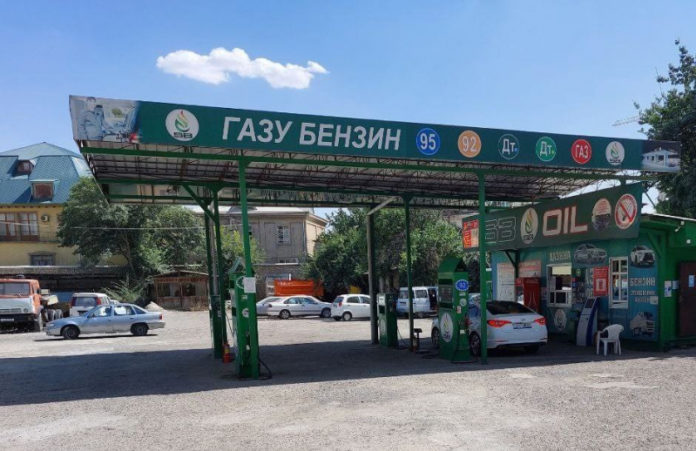
In recent days, Tajikistan’s capital, Dushanbe, has been experiencing a severe shortage of liquefied gas, which has become the most popular type of automotive fuel in the country due to its relative affordability.
At the beginning of the week, liquefied gas was sold at 5.8 somonis per liter at gas stations in the capital. However, over the past two days, the number of stations selling this type of fuel has gradually decreased, and those still offering it have raised the price to 7.00 somonis per liter.
Gas station attendants said that the price hike has resulted from the rising cost of liquefied gas in Kazakhstan, which provides the bulk of Tajikistan's liquefied gas fuel imports.
An official source within the Antimonopoly Agency under the Government of Tajikistan told Asia-Plus that they could only comment on this issue in writing after receiving an official request. It's worth noting that ministries and agencies typically respond to written inquiries from journalists within two weeks, as stipulated by law, but in practice, it often takes much longer, and sometimes there is no response at all.
The Kazakh Ministry of Energy recently announced a price adjustment for liquefied gas effective from July 1, citing several reasons, with the main one being the unprofitability of producing this type of fuel.
The Ministry of Energy of Kazakhstan last month published for public discussion, a draft by the Minister of Energy to increase the price of liquefied petroleum gas (LPG) from July 1.
The maximum wholesale price of one ton of LPG has been increased from the current 40,320 tenge to 45,158 tenge, and the maximum retail price has been increased slightly — by 5.00-8.00 tenge per liter, depending on the region.
Cheaper than gasoline, LPG is the most popular fuel for vehicle owners in Kazakhstan. A sharp hike in the price of LPG was met with nationwide objection in January, triggering mass protests in Zhanaozen which spread nationwide and turned violent in Almaty and Astana.
The ministry issued several reasons for what will be an unpopular move.
First, the price of LPG is much lower than the cost of its production. The production cost of LPG varies from 60,000 to 70,000 tenge per ton, whereas the current maximum wholesale price is 40,320 tenge per ton.
Second, LPG consumption in Kazakhstan increases year on year. Increasing consumption and the unprofitability of LPG production due to low prices have led to a decrease in the production of the fuel and its shortage in the regions. Kazakhstan’s Ministry of Energy says today the deficit of LPG reportedly stands at 20-25%.
Third, due to unprofitability, manufacturers are increasingly losing interest in LPG production and switching instead, to more profitable products. For the same reason, investors are also reluctant to invest in its production.
Fourth, the price of LPG in Kazakhstan, between 54-86 tenge per liter depending on the region, is the lowest among former Soviet states. For comparison, the price per liter in Russia is equivalent to 132 tenge; in Kyrgyzstan, 159 tenge; in Azerbaijan, 171 tenge; and in Tajikistan, 273 tenge.
In Tajikistan, liquefied gas is included in the list of socially significant goods (19 items) regulated by the Antimonopoly Agency, although there are no dominant companies in this market.
According to statistics, Tajikistan imported over 411,000 tons of liquefied gas last year, with 76% from Kazakhstan, about 20% from Russia, and about 4.0% from Uzbekistan. Currently, there are restrictions on the export of liquefied petroleum gas in Kazakhstan. However, these export bans do not apply to companies supplying liquefied gas to Tajikistan based on interstate agreements.
According to data from the Ministry of Economic Development and Trade (MoEDT), more than 60 percent of motor vehicles in the country use liquefied natural gas as fuel.
The shortage of liquefied gas in Dushanbe and the subsequent price increase highlight the city's reliance on imports, particularly from Kazakhstan. This dependency has made the market vulnerable to external price changes and supply disruptions, necessitating better regulatory mechanisms and diversified sources to ensure stable and affordable fuel supplies.