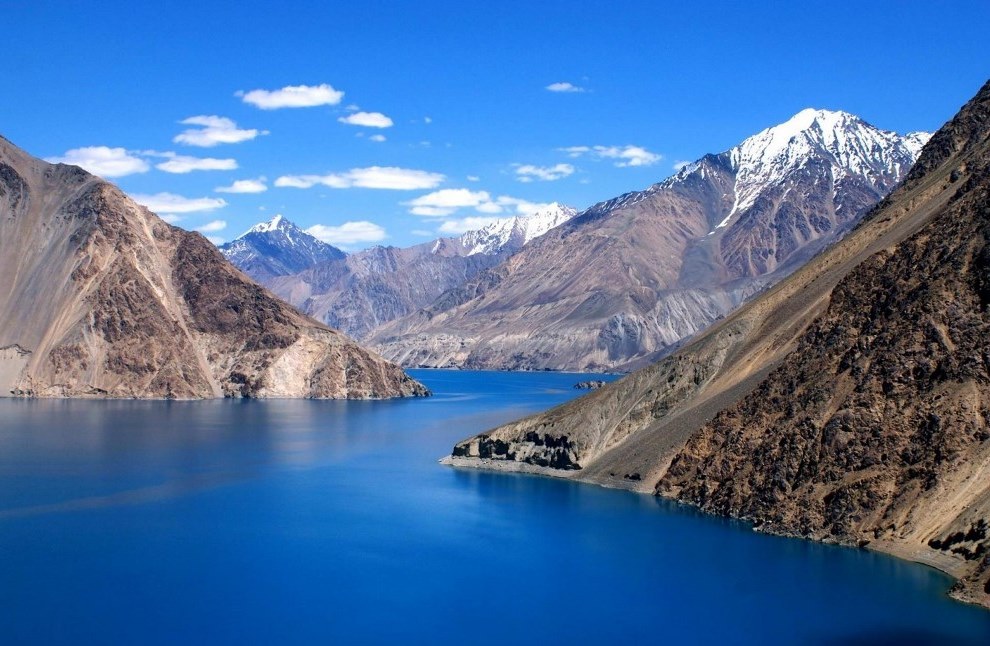
The possibility of using resources from Lake Sarez to provide that countries of the region with safe drinking water has been discussed at a meeting of the Tajik-Uzbek joint working group on integrated use of water resources of Central Asia’s transboundary rivers.
Co-chaired by the Minister of Energy and Water resources of Tajikistan Daler Juma and the Minister of Water Resources of Uzbekistan Shavkat Hamrayev took place in Dushanbe on August 3.
The Ministry of Energy and Water Resources of Tajikistan (MoEWR) says of the Tajik-Uzbek joint working group on integrated use of water resources of Central Asia’s transboundary rivers discussed issues related using resources of Lake Sarez to provide the countries of the region with safe drinking water and opportunities of implementation of new joint cross-border projects in the water sector.
The parties reportedly expressed the belief that the collaboration between the friendly countries in water sector will be expanded in the future as well.

They expressed intention to expand cooperation on joint use of water resources.
The issue of how to exploit resources from, Lake Sarez was discussed during Tajik President Emomali Rahmon’s state visit to Uzbekistan in August of 2018. “We could use water from Lake Sarez to supply drinking water to the region,” Tajik leader was cited by media outlets as saying at the time.
It was also reported in early August 2014 that Iran is looking for more water and some Iranian officials believe the place to get it is from Tajikistan. Some of them reportedly came up with a new and novel proposal and suggested building a pipeline to get the water from Lake Sarez. There were plans to build the Dashtijum hydropower plant downstream from Sarez and suggested the water could enter the proposed pipeline after it spills out from the plant.
Homidjon Oripov, the then official in Tajikistan's energy department, told Radio Liberty’s Tajik Service in August 2014 that the idea of exporting water to Iran goes back some 10 years, when an Iranian company sent a letter about water exports to Tajik President Emomali Rahmon. The Iranian government was reportedly prepared to invest $3 billion in a project to bring the water to Khorasan.
RFE/RL’s Tajik Service reported at the time that initial proposal was scrapped, but in 2007 President Rahmon and then-Iranian President Mahmud Ahmadinejad signed an agreement on the export of water from Tajikistan to Iran. And in fact, as of the start of 2013 Tajikistan was supposed to be exporting 1 billion cubic meters of potable water to Iran. However, that has not happened so far.
More than 113 years have passed since Lake Sarez formed in the Gorno-Badakhshan Autonomous Region (GBAO).
“A strong tremor was felt in Khorog on February 12, 1911, about midnight. In the village of Sarez, people rushed out of their houses, screaming with horror. Two houses collapsed, four gave cracks. A wild ramble was heard from the west. It merged with the howl of falling avalanches. In the morning, everything was covered with dust hanging in the air, and the land continued to shake. When the boys reached Usoy, they did not see the village. A huge mountain of rock was in its place.” That was the beginning of the Lake Sarez story.
The earthquake was reportedly estimated at 6.5-7.0 on Richter scale. Deaths were estimated at 302. The landslide was 2.2 million cubic meters and formed the Usoy Dam, which is 3km long and 550m high, the tallest natural dam in the world. The village of Usoy was buried under the landslide. It was not until April 1914 that the lake rose high enough to begin flowing over the dam. The lake reached its current level in 1920. The area was so isolated and the destruction of mountain tracks so complete that it took six weeks before word reached the Russian posts at Murgab and Khorog.