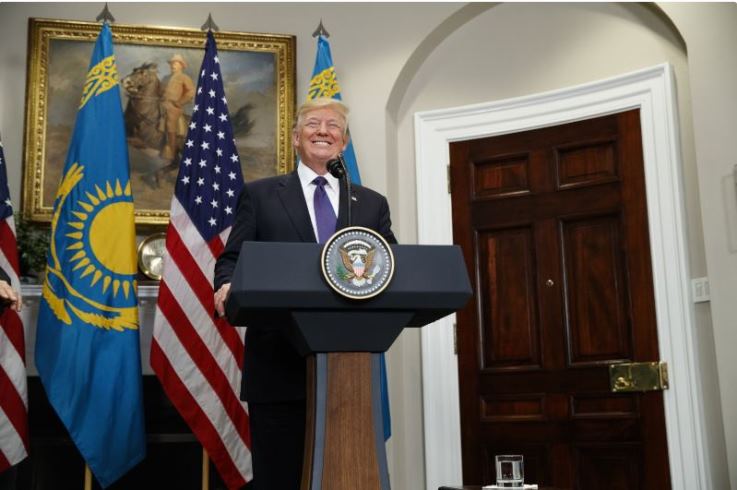
Some Western experts believe that the five Central Asian countries will not be at the top of President-elect Donald Trump’s new foreign policy agenda, but they won’t be at the bottom either.
The first Trump administration was well aware of the region and saw significant promise for U.S. engagement with Kazakhstan, Kyrgyzstan, Tajikistan, Turkmenistan, and Uzbekistan.
The Diplomat says hosting the presidents of Kazakhstan and Uzbekistan for rare official visits to the White House, the former Trump administration also adopted the 2019-2025 U.S. National Security Strategy for Central Asia – a whole-of-government strategy that has resulted in the region becoming a regular component of U.S. policy, no longer an afterthought. The Trump-era strategy was reportedly adopted unchanged by the Biden administration and remains in effect today and ready to be updated.
According to The Diplomat, significant changes have taken place over the last four years in the region since Trump was last in office, but the region’s transformation could work well with Trump’s espoused interests and the likely transactional style of a new Trump foreign policy. Many of the tools and approaches used in the first Trump administration reportedly could be reprised to yield significant benefits and a deeper U.S. and Central Asian partnership. The Central Asian states have emerged as a region interested in pursuing efforts to secure their economic sovereignty from neighboring Russia and China.
As a result, new opportunities for the United States, particularly in expanding the U.S. business sector in Central Asia, may prove irresistible to the new leadership and its businessman boss. Central Asia’s gas and oil wealth is reportedly expected to be a key area of attention for the new Trump administration.
Meanwhile some experts consider that Trump’s White House comeback may alter Central Asian ties.
Daily Sabah reports that under Trump, the U.S. could potentially engage in a more proactive approach toward Central Asia. His willingness to challenge established norms reportedly may open doors that have long remained closed. For instance, Trump already demonstrated a willingness to enhance diplomatic ties with the region. His involvement with the C5+1 platform – a diplomatic forum that includes the five Central Asian republics: Kazakhstan, Kyrgyzstan, Tajikistan, Turkmenistan, and Uzbekistan – is a notable example. This initiative has opened new channels for dialogue and cooperation, highlighting the importance of mutual interests in the region.
Bruce Pannier, an American journalist who has long covered the region, however, says: “I think Central Asia will almost disappear from the U.S. foreign policy radar. Trump wasn’t very interested in Central Asia when he was president and when U.S. troops were in neighboring Afghanistan.”