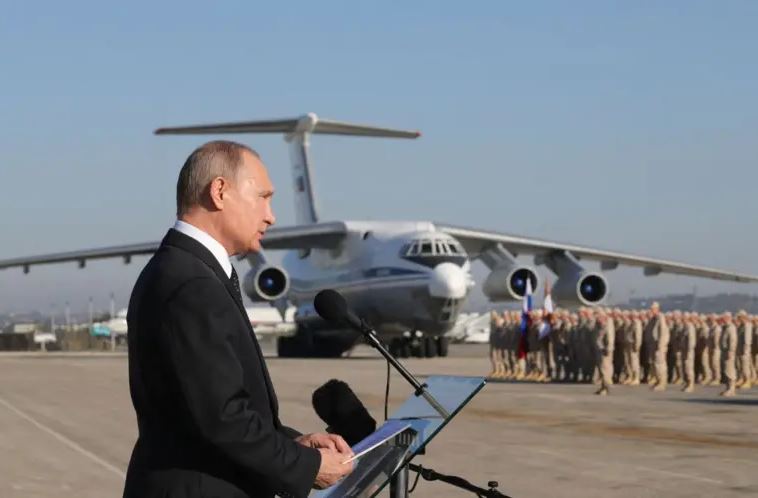
The BBC’s Russian Service reported on December 10 that Vladimir Putin supported Bashar al-Assad during the Syrian civil war, and since late September 2015, a large Russian military contingent has been stationed in the country. At the beginning of 2024, its size was unofficially estimated at about 7,500 personnel. With the fall of Assad’s regime, the fate of this contingent is now in serious question.
The two largest Russian military facilities in Syria are the naval base in Tartus and the Khmeimim airbase, about 20 kilometers southeast of Latakia. However, Russian officials insist that the Tartus site is not a full-fledged base but merely a technical support point for ships.
In addition to these two major sites, auxiliary positions and checkpoints are believed to have been set up around them.
In 2017, Moscow and Damascus signed a 49-year agreement for the use of the Tartus and Khmeimim bases, valid until 2066. However, it is now unclear whether they will remain under Russian control.
Russian leadership has reportedly signaled that it does not plan to continue using these two bases indefinitely. The Kremlin spokesman Dmitry Peskov stated on Monday that their fate will be discussed with the new authorities in Damascus.
Shortly before this, CNN Turk reported that Russia requested Turkiye’s support for the safe withdrawal of its troops from Syria. However, this request pertains not to the major bases but to troops stationed in remote positions across the country.
Just weeks ago, Russian forces were deployed across various locations in Syria, with distances between military sites spanning hundreds of kilometers. Now, some Russian military groups find themselves cut off from the main forces.
On one hand, the chairman of the State Duma’s Defense Committee, Andrey Kartapolov, declared that Russian bases and military contingents in Syria face no threats and that there are no isolated units.
On the other hand, social media posts allegedly show photos of Russian soldiers who have been cut off from their bases. Verifying such reports is difficult under current conditions, according to the BBC’s Russian Service.
Videos appearing on social media, reportedly showing Russian equipment on Syrian roads, suggest that troops are attempting to move out of remote areas.
Sergey Naryshkin, head of Russia’s Foreign Intelligence Service, stated that Russia is negotiating with the new authorities in Syria to ensure the safety of Russian citizens, focusing primarily on diplomats and other officials.
If CNN Turk’s report is accurate and Russian command has reached out to Turkiye for assistance in troop withdrawal, this could help evacuate personnel from remote areas—but not from all locations.
This support would be effective only to the extent that Turkish forces themselves control the situation. Russian troops are spread across various regions of Syria, including areas with no Turkish presence.
To withdraw troops to Tartus or Khmeimim, from where they could be evacuated to Russia, negotiations will be necessary with multiple parties.
Russian military bloggers reportedly note that the greatest threat to Russian troops now comes from potential airstrikes by the U.S. or Israel.
Israel has stated that it is targeting suspected sites of weapons and missile production to prevent their transfer to extremists. Meanwhile, the U.S. announced that its airstrikes over the weekend hit more than 75 targets, including sites housing leaders and fighters of the terrorist group "Islamic State," aiming to prevent them from exploiting the political and military uncertainty following the Syrian government’s collapse.
Thus, withdrawing troops from remote positions is a challenging task requiring coordination among numerous stakeholders.