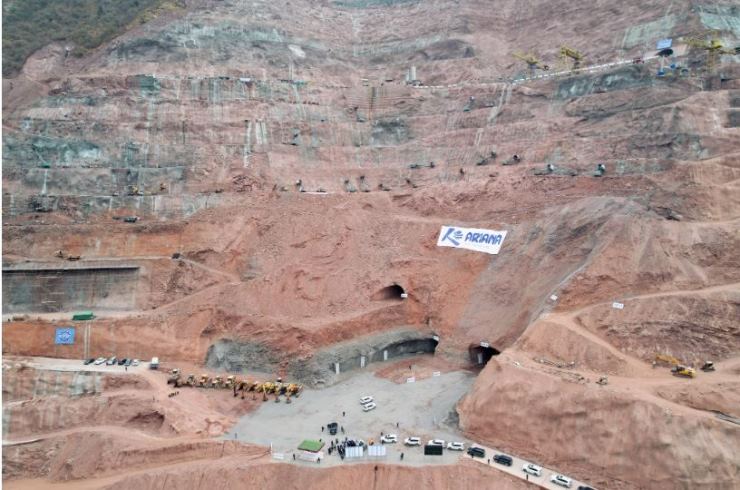
The report, compiled by the Kazakhstan-based environmental organization Rivers without Boundaries claims that building the Roghun Dam in Tajikistan to its maximum projected height and specifications would be an economic disaster for Tajikistan, and an environmental nightmare for the entire region. The advent of new technologies for electricity generation reportedly means that Tajikistan’s already decades-old mega project would be outdated before it became fully operational.
The report is expected to be distributed shortly before a World Bank Board of Directors meeting, scheduled for December 17, is due to discuss financing options for the Roghun project, the costs of which have spiraled upward in recent years. Current projections put the price tag of completing the dam at its projected height of 335 meters at $6.4 billion.
Experts assembled by Rivers without Boundaries reportedly compiled data on eight different scenarios for achieving the Roghun project’s intended goal of producing enough electricity to both meet the country’s domestic needs and generate revenue via the export of power. The results contained in the report suggest that a mix of renewable power generation, along with the completion of a significantly smaller Roghun Dam, would be the optimal solution.
The report says the environmental and social impact assessments that officials are relying on for the Roghun project are outdated, relying on over decade-old data. Since then, there have reportedly been major advances in wind and solar power generation technologies, and the risks posed by global warming in Central Asia have risen.
According to the report, the cost of Roghun's electricity will be more expensive than that generated by solar photovoltaics (SPP) and wind (WPP) power plants. If Tajikistan intends to become an electricity exporter to its neighbors, it reportedly needs to develop SPP and WPP.
Environmentalists reportedly say the alteration of the water flows of the Vaksh and Amu Darya rivers caused by Roghun construction and operation to date already has degraded regional ecosystems, and “worsened conditions for irrigation in dry years.”
Roghun would also be a potent source of greenhouse gasses at a time when Central Asia is straining to curtail emissions as part of an effort to slow global warming, according to the report.
Meanwhile, World Bank’s report notes that the Roghun hydropower plant promises significant benefits for Tajikistan and Central Asia, contributing to decarbonization, strengthening regional energy systems, and transformation of Tajikistan's economy.
The report highlights that the modern facility, which is scheduled to be completed by 2037, will meet Tajikistan’s internal electricity demand, stimulate economic growth, and increase revenue through exports.
The authors of the report clarify that the plant should reach full capacity (3.78 gigawatts) by 2034 and increase water storage by 13.3 billion cubic meters (BCM) by 2037.
World Bank representatives expect that around 70% of electricity generated by the Roghun HPP will be exported, which will help replace fossil fuel electricity production in Kazakhstan and Uzbekistan.
The report emphasizes that this plant will become the main pillar of Tajikistan’s power system and the "core of the regional electricity market in Central Asia."
Once completed, Roghun HPP will be the largest hydropower plant in Central Asia, with an installed capacity of 3,600 MW. Its annual electricity generation after full commissioning will range from 13 to 17 billion kilowatt-hours, accounting for about 65-85% of Tajikistan's total annual electricity production.