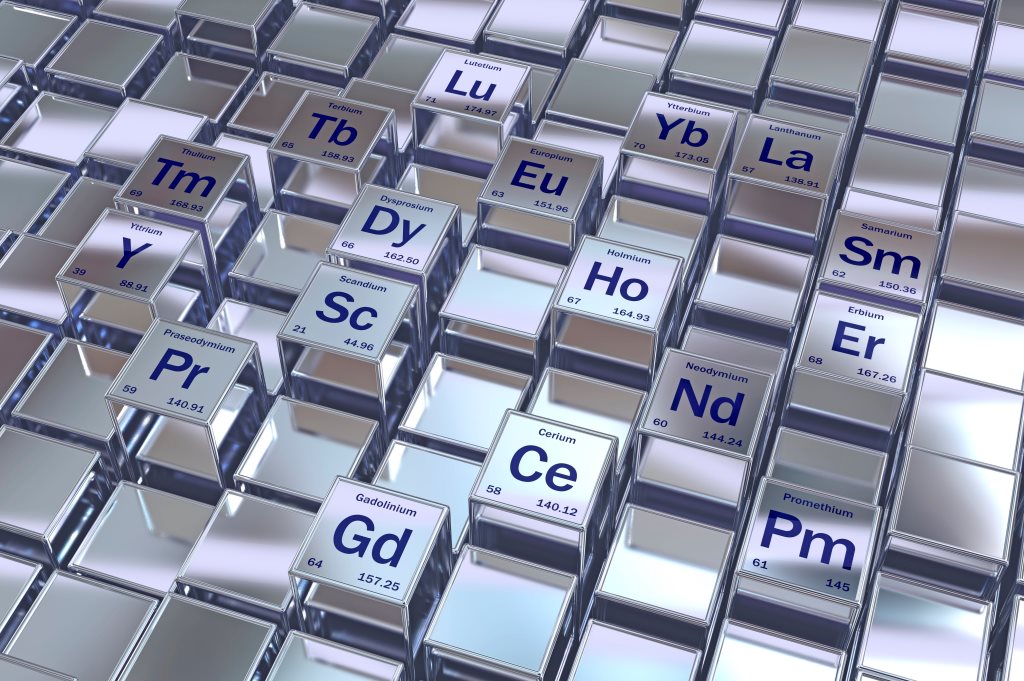
US President Donald Trump announced that during the visit of Ukrainian President Volodymyr Zelensky to Washington on February 28, a bilateral agreement "on rare earth metals and other matters" will be signed, the BBC reports.
This deal has been the main topic in recent weeks – without its conclusion, Trump has refused to offer support to Kyiv in the war.
Ukraine holds vast deposits of rare earth and other critical minerals, but many of these are located in areas controlled by Russian forces. According to Trump, Ukraine must hand over these resources to the US for the country's leadership to continue supporting Ukraine in its war against Russia.
"I told [Ukraine] that I want the equivalent of rare earth metals worth around US$500 billion, and they essentially agreed to do it," Trump said in an interview with Fox News on February 10.
In response, Zelensky called this conversation “not serious,” adding that “he cannot sell the country.” After a few weeks, during which the rhetoric of the US towards Kyiv became increasingly harsh, his position began to change.
On February 26, commenting on the potential agreement, Zelensky emphasized that for him, the main issue is continued assistance from the US. According to him, the preliminary deal on minerals is "just the beginning, the foundation, and it could become a great success."
Trump's proposal shows how important mineral resources on Ukrainian territory are to the US. But why does the US need them, and what could they provide?
What minerals are found in Ukraine?
Ukraine holds 21 out of 30 substances that the European Union (EU) defines as "critical raw materials," making up about 5% of the world's reserves.
Many of the territories containing these minerals are located in the southern part of the Ukrainian crystalline massif, primarily under the Sea of Azov. The majority of these areas are currently occupied by Russia, but Ukraine still has promising projects in the Middle Pobuži region, as well as in Kyiv, Vinnytsia, and Zhytomyr regions.
According to experts, despite the identification of several hundred promising geological sites in Ukraine, only a few may become deposits if their development is deemed economically viable.
“The estimates that have been published are very rough,” says Adam Webb, head of the battery raw materials division at Benchmark Mineral Intelligence. “Much more work needs to be done to prove that these mineral deposits are economically viable.”
In terms of other important Ukrainian minerals, according to Forbes Ukraine, about 70% of them are located in Donetsk, Dnipropetrovsk, and Luhansk regions. Thus, many are in areas occupied by Russia.
In addition to rare earth minerals, Ukraine also has deposits of critical minerals like lithium. According to the Ukrainian government, the country's lithium reserves are about 450,000 tons. Lithium extraction in Ukraine is not yet underway, though plans exist to start.
Currently, Russia occupies at least two lithium deposits: the Shevchenkivske in Donetsk region and the complex ore deposit at Krutaya Balka in the Berdyansk district. Lithium ore deposits in the Kirovohrad region remain under Ukrainian control.
Why does Trump need these minerals?
The US interest in controlling the extraction of rare earth metals and potentially critical minerals is largely driven by competition with China.
In recent decades, China has become a leader in the extraction and processing of rare earth minerals. It accounts for 60-70% of global production and nearly 90% of processing capacity.
The US's dependence on China in this area is likely to concern the Trump administration – both in terms of national security and the economy. These materials are necessary for creating complex technologies, from electric vehicles to military equipment.
“At first glance, this seems like a paradox. Trump ordered the expansion of fossil fuel production, rejecting renewable energy policies. At the same time, he wants to acquire critical minerals – key for the transition to clean energy – from anywhere he can. However, these minerals are also building blocks for consumer electronics, military and navigation equipment, and, crucially, artificial intelligence (AI) data centers.
“Earlier, Trump announced a large-scale expansion of AI infrastructure in the country. This will require vast supplies of critical minerals – primarily copper, silicon, palladium, and rare earth elements. And the supply of critical minerals has already started to shrink, becoming one of the main reasons for the slowdown in global clean energy growth,” comments BBC World Service correspondent Navin Singh Hadda.