The year 2024 was challenging for Tajikistan’s cotton industry—harvest volumes dropped significantly, and farmers faced economic and climatic difficulties. Problems with cultivation, forced cotton production, and unfavorable production conditions were the key challenges for this vital sector.
Climatic challenges
According to the Minister of Agriculture, Qurbon Hakimzoda, the main reasons were unfavorable climatic conditions and errors in agricultural techniques. In the spring and autumn, Tajikistan experienced abnormal rainfall, delaying the planting season to 65 days instead of the standard 10-15.
Late sowing shifted the harvest period to autumn, when heavy rains worsened cotton quality and prevented completion of the harvest. The summer heat also played a role—soil temperatures in southern Tajikistan exceeded permissible levels in August, destroying a significant portion of the crop.
The Agricultural Sciences Academy believes that the problems are not limited to climate factors. The Academy’s president, Amonullo Salimzoda, noted that despite the supply of quality seeds, farmers did not always follow proper cultivation techniques. One of the key issues was improper irrigation: due to extreme heat, many farmers began watering too early, leading to root rot.
Farmers also made mistakes in thinning the plants and pruning tops, which reduced nutrient availability for cotton bolls. The lack of qualified agronomists worsens the situation. The country has about 200,000 dehqon (peasant) farms, but not all landowners have the necessary knowledge.
Consequences of forced cotton cultivation
Cotton is traditionally considered a strategically important crop for Tajikistan. Agriculture accounts for over 20% of the country’s GDP, and cotton makes up a significant share of exports. However, farmers increasingly complain about its low profitability and forced cultivation.
Farmers claim that authorities force them to allocate large portions of their land to cotton, even when it results in losses.
At a recent press conference, the Minister of Agriculture stated that farmers are free to choose their crops and sell cotton on the open market. However, in practice, those who do not follow the government’s "recommendations" face bureaucratic obstacles that hinder their access to land and resources.
The economic unfeasibility of cotton farming
The average purchase price for cotton was 6-7 somonis per kilogram, which is lower than the production cost. Farmers spend around 15,000 somonis per hectare, while their revenue does not exceed 12,000 somonis, leading to losses.
Meanwhile, on the global market, cotton costs 15-16 somonis per kilogram, but farmers cannot sell directly.
Experts believe the problem lies in the absence of market mechanisms. They point out that the procurement system benefits intermediaries rather than producers. Without subsidies and higher purchase prices, farmers will not be able to sustain cotton farming.
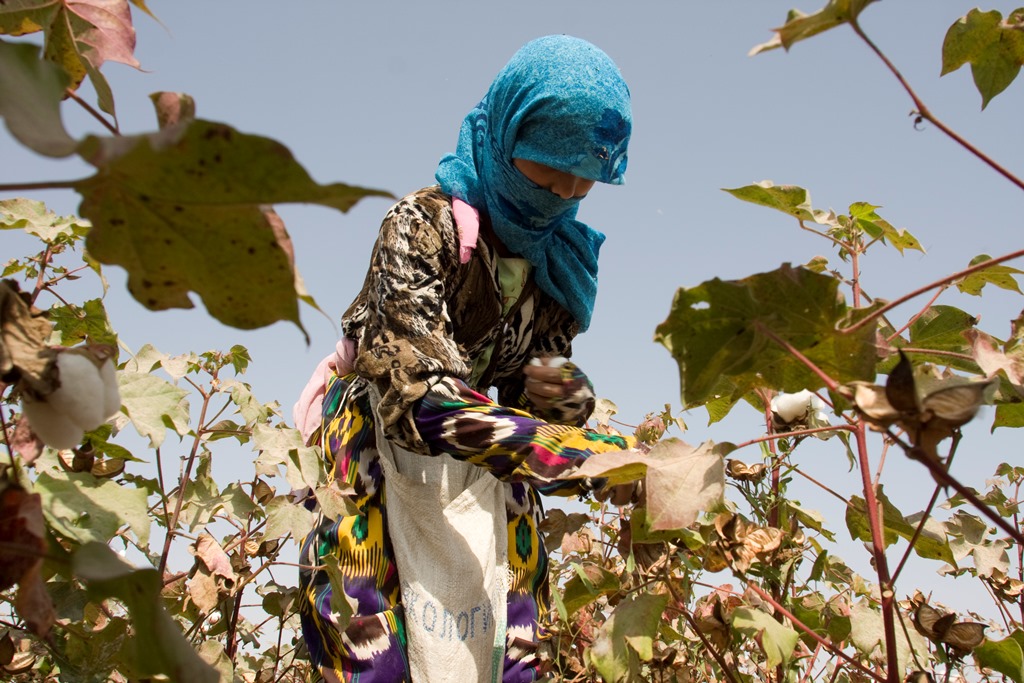
Low income affects not only farmers but also cotton pickers. They earn 50 somonis per day, while construction workers and other seasonal laborers make up to 200 somonis.
In Uzbekistan, the government subsidizes cotton harvesting, paying 2.1 somonis per kilogram, making this work more attractive.
How to make cotton farming profitable?
Analysts believe that for cotton farming to be profitable, the yield must exceed 30 quintals per hectare. Otherwise, farmers risk financial losses. However, last year, some farms harvested only 8-10 quintals per hectare.
Experts recommend adopting mulching and double-row planting technologies, which allow for higher yields on smaller plots. This method has proven effective in China. Traditionally, 95,000-100,000 plants are sown per hectare, whereas with innovative methods, 220,000-250,000 plants can be cultivated.
Practical experience already shows these methods' effectiveness. For example, farmers in Dousti and Levakant districts achieved high yields despite climate changes by using mulching and drip irrigation.
Export vs. processing: the future of Tajikistan’s cotton industry
Tajikistan has around 30 textile factories that process 20,000 tons of cotton annually. However, a significant portion of this fiber is exported. If the country increased processing and produced finished goods, profits from the cotton industry could grow 5-7 times.
Experts urge the government to focus on domestic cotton processing. This would not only increase product value but also create jobs and ensure stable income for farmers.
In 2024, cotton exports brought Tajikistan over US$211 million, making the industry attractive for the national budget. However, for farmers, this approach does not yield substantial income.
Cotton prices are expected to rise in the coming years. The World Bank forecasts a 5% increase in global cotton prices in 2025, reaching US$2.00 per kilogram, with an additional 2.5% increase in 2026, bringing the price to $2.05 per kilogram.