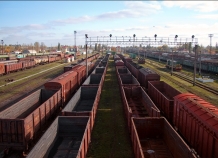
The Middle Corridor trade route is filling out. China and Kazakhstan have announced the launch of a new freight rail transit line that will deliver Chinese goods to Europe while bypassing Russia, Eurasianet reported on March 5.
The Middle Corridor, also called TITR (Trans-Caspian International Transport Route), is a trade route from Southeast Asia and China to Europe via Kazakhstan, Caspian Sea (using train ferries to cross the Caspian), Azerbaijan, Georgia and Turkiye.
Kazakstan Railways says the subsidiary of JSC Kazakhstan Railways, JSC "KTZ Express, in collaboration with China Railway Container Transport Co., Ltd. (CRCT), has launched a new container service, opening an additional route between China and Europe.
The first container train following the new route reportedly departed Chengdu in central China on March 4 heading for the Polish city of Lodz. The train, carrying televisions and other electronic components, is expected to complete the journey within 40 days, traversing Kazakhstan, Turkmenistan, Iran and Turkiye before reaching the European Union’s border.
This new route not only expands the region's transport capabilities but also enhances international logistics by making it more flexible, faster, and more reliable. The launch of the service reaffirms Kazakhstan’s strategic role as a key transit hub and strengthens its position on the global freight transportation map.
China is reportedly also developing two additional westbound freight transit routes that circumvent Russia via Kazakhstan and across the Caspian Sea, depriving the Kremlin of transit income and denting its geopolitical leverage.
Meanwhile, Uzbekistan’s state railway agency announced the launch of a new freight transit route connecting India to Kazakhstan. Twelve containers were recently loaded onto a freighter at the Indian port of Mundra for transport to the Iranian port of Bandar Abbas. From there, the containers will make their way by rail via Turkmenistan and Uzbekistan before reaching its destination outside Kazakhstan’s capital, Astana. The total travel time for the shipment of ceramic tiles is estimated at 25-30 days.
The new route reportedly has the potential to significantly reduce transport costs, while “broadening opportunities for exporters and importers.”