Top Russian diplomat disagrees with Kazakh president’s position on a nation’s right to territorial integrity

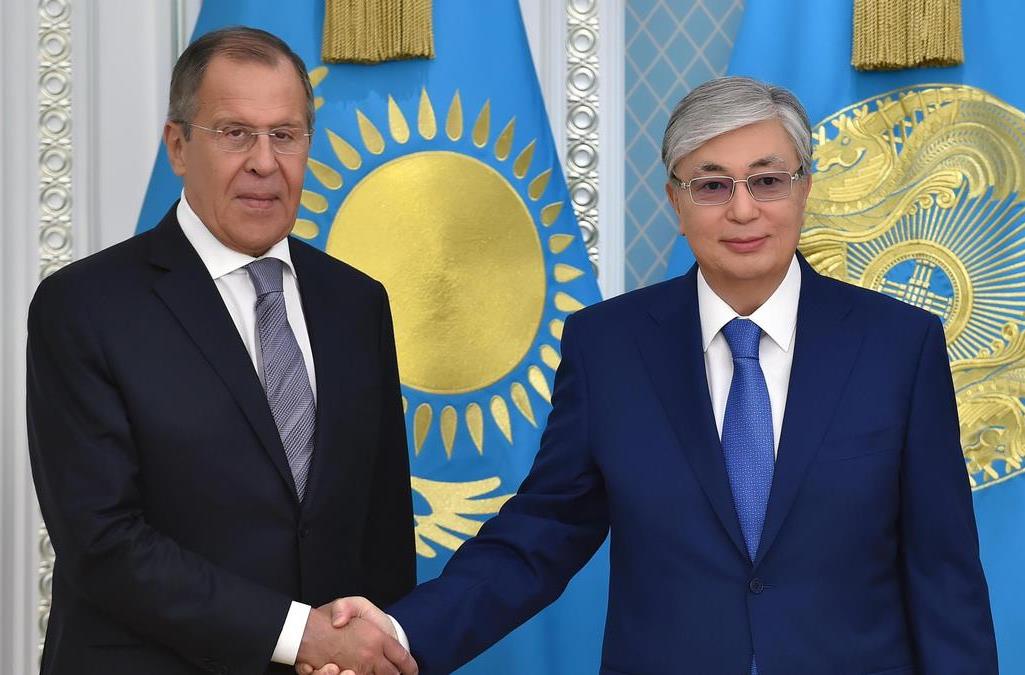
Russian Foreign Minister Sergey Lavrov does not support the position of Kazakhstan's President Kassym-Jomart Tokayev on the right of nations to territorial integrity. He made this statement in an interview with Kommersant. The journalists referred to Tokayev's statement, where he noted that if one relies solely on the principle of the right of nations to […]

Russian Foreign Minister Sergey Lavrov does not support the position of Kazakhstan's President Kassym-Jomart Tokayev on the right of nations to territorial integrity. He made this statement in an interview with Kommersant.

The journalists referred to Tokayev's statement, where he noted that if one relies solely on the principle of the right of nations to self-determination, many regional conflicts could arise in the world.  In the summer of 2022, he expressed that this principle, enshrined in the UN Charter, contradicts another principle – territorial integrity.  Tokayev emphasized that if this principle were fully implemented, more than 600 states could emerge, leading to chaos.

Lavrov noted that he remembers this speech but does not share Tokayev’s point of view, adding that Moscow later clarified its position to Astana.

“For him, there is only the right to territorial integrity.  But I will say again: if you are members of the UN, you must respect the Charter in its entirety,” he explained.

Lavrov added that the right to territorial integrity is “respected by those states whose governments represent all the people living in the territory.”

“No colonial power ever represented the entire population of the territory it colonized.  This doesn't require proof!  Paris, Lisbon, Madrid, and London didn’t represent the people.  That’s why the decolonization process went in full accordance with the UN Charter," Lavrov pointed out.

Tokayev has repeatedly expressed Kazakhstan's commitment to the principles of sovereignty and territorial integrity of all states based on international law.  For this reason, Kazakhstan does not recognize Taiwan, Kosovo, South Ossetia, or Abkhazia, he stated in the summer of 2022.

At that time, he also referred to the Donetsk and Luhansk People’s Republics as “quasi-state territories” (at that point, Moscow had not yet annexed them).  It is worth noting that the majority of states do not recognize the referendums that led to these regions becoming part of Russia.
Join us on social media!

Article translations:

Related Article

Оби зулол
Tenisi
Оби зулол

Most Read

Коммерсбонк Точикистон

Recent Articles

RZD announces the restoration of passenger services between Moscow and Dushanbe

Direct rail services between the capitals of Russia and Tajikistan were suspended in March 2020 due to the COVID-19 pandemic.

#AP30/Stories. “Selam! Heller nichek?” How Tatars live today in Sughd province

On the 30th anniversary of "Asia-Plus," we continue to publish reports that remain relevant even after years. This story was told in 2021, and since then, little has changed in the life of the Tatar community in Tajikistan.

15,000 cameras, drones, and robots: how technology monitors pilgrims in Mecca and Medina

During Hajj 2026, Mecca and Medina were under unprecedented digital control.

Another child in Dushanbe removed from family and sent to boarding school

The Ministry of Internal Affairs reports that the parents did not pay adequate attention to the child.

Emomali Rahmon instructs to address issues in seed production following criticism of the industry

Issues have been noted with certification, seed quality, and the material and technical base of the industry.

Water, climate, and a $130 billion deficit: seven key outcomes of the Water Conference in Dushanbe

At the forum, countries and international organizations discussed new mechanisms for cooperation, investments, and technologies that are essential for addressing the global water crisis.

Eskhata Bank introduces a new generation children’s wallet

"Eshkata Bank" has created a full-fledged digital platform that helps children aged 7 to 16 learn how to manage money.