
Out of 193 countries featured in the Human Development Index (HDI) 2025, Tajikistan ranked 128th, placing it in the "Medium" human development category.
The Human Development Summary reflects progress in HDI and includes additional indicators that account for gender disparities, inequality, planetary pressure, and multidimensional poverty.
For Tajikistan, the data spans the period from 1993 to 2023.
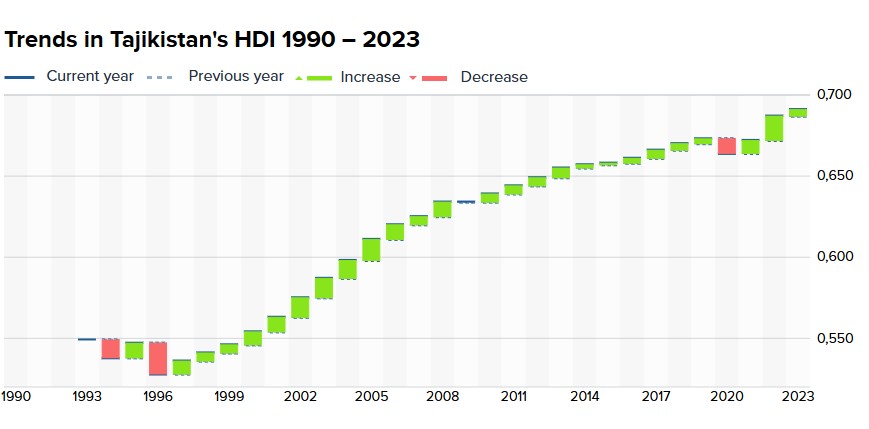
As shown in the chart below, the country’s HDI has significantly improved during this time.
“From 1993 to 2023, Tajikistan’s HDI value rose from 0.549 to 0.691, an increase of 25.9%,” the authors note.
Other key improvements from 1993 to 2023 include:
- Life expectancy at birth increased by 16.28 years
- Expected years of schooling rose by 0.03 years
- Mean years of schooling improved by 1.39 years
- Gross National Income (GNI) per capita grew by approximately 136.9%
The Human Development Index, or HDI, is a metric compiled by the United Nations Development Programme and used to quantify a country’s “average achievement in three basic dimensions of human development: a long and healthy life, knowledge, and a decent standard of living.” The HDI was first launched in 1990 and has been released annually ever since, with the exceptions of 2012 and 2020/21. While HDI tends to trend upward globally over time, more than 90% of the 191 countries analyzed for the 2021/22 HDI report suffered a decline in overall HDI in either 2020 or 2021. These declines were largely attributed to the COVID-19 pandemic and its lingering effects.
A country’s Human Development Index value is determined by aggregating the country’s scores in a vast assortment of indicators including life expectancy, literacy rate, rural populations’ access to electricity, GDP per capita, exports and imports, homicide rate, multidimensional poverty index, income inequality, internet availability, and many more. These indicators are compiled into a single number between 0 and 1.0, with 1.0 being the highest possible human development. HDI is divided into four tiers: very high human development (0.8-1.0), high human development (0.7-0.79), medium human development (0.55-.70), and low human development (below 0.55).