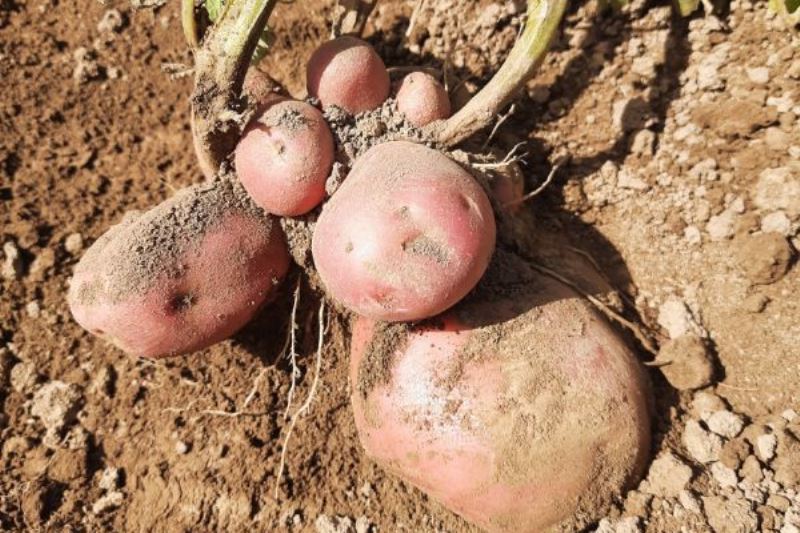
The potato harvest for the new season has officially started in Tajikistan, with over 5,500 tons collected since May 16. Despite the promising start, the total area planted with potatoes this year has decreased by more than 20% compared to last year, raising concerns about the country’s food security.
According to the Ministry of Agriculture (MoA), harvesting has begun on 356 hectares, yielding an average of 160.5 quintals per hectare. However, the total sown area this year stands at 31,463 hectares — a significant decline from the 39,670 hectares planted in 2024.
The Ministry of Economic Development and Trade (MoEDT) forecasts potato production of approximately 1.18 million tons in 2025. Yet, President Emomali Rahmon expressed concern over the slow pace of planting during a government seminar held on May 17 in Danghara district. He stated, “The implementation of the potato sowing forecast is only 73%.”
President Rahmon emphasized that ensuring a stable food supply is a strategic priority. He urged the MoA and regional authorities to accelerate spring planting, provide farmers with quality seeds and fertilizers, and intensify efforts to meet the planned quotas, particularly for potatoes.
Meanwhile, Tajikistan continues to rely heavily on potato imports to meet domestic demand. Data from the Customs Service under the Government of Tajikistan shows that nearly 30,000 tons of potatoes were imported between January and April 2025, valued at approximately US$5.3 million. Of this amount, 550 tons were seed potatoes, costing US$0.28 per kilogram, while other potatoes averaged US$0.18 per kilogram.
For context, Tajikistan imported over 80,000 tons of potatoes worth US$17.2 million in 2024 and 47,000 tons worth US$11.36 million in 2023. The current import volume already represents more than 37% of last year’s total, with the average price per kilogram showing a downward trend from previous years’ US$0.21.
As of May 19, the average retail price of potatoes across Tajikistan stands at about 5.88 somonis per kilogram. Prices vary regionally — the lowest recorded in Jayhun district of Khatlon province at 5.00 somonis, and the highest in Murgab district of the Gorno Badakhshan Autonomous Region (GBAO) at 7.75 somonis.
In Dushanbe, prices fluctuate between 5.80 and 6.50 somonis, while Bokhtar and Kushoniyon see prices around 6.00 somonis.
GBAO’s, capital, Khorog, and Sughd’s capital, Khujand, report prices between 6.00 and 6.30 somonis, consistent with last year’s range.
The government’s call to boost domestic production reflects ongoing efforts to reduce import dependence and strengthen the nation’s agricultural sector amid global food security challenges.