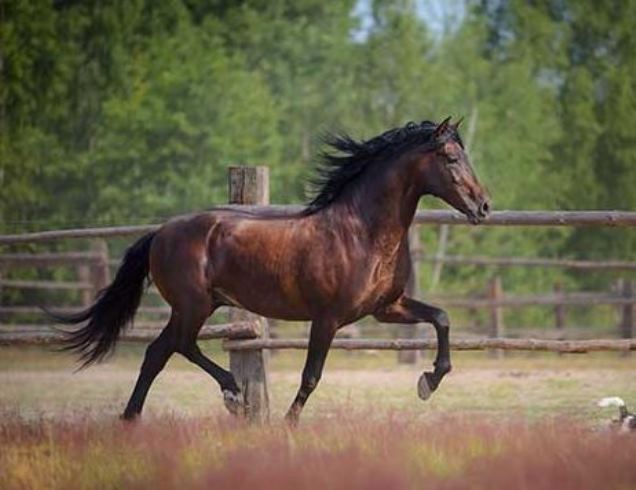
UN General Assembly adopts draft resolution “Proclaiming July 11 as World Horse Day”

The 79th Session of the United Nations General Assembly discussed and adopted the draft Resolution on "Proclaiming July 11 as World Horse Day," initiated by President of Mongolia Khurelsukh Ukhnaa, on June 3, 2025. Co-sponsors of the draft Resolution were the Republic of Austria, the Kingdom of Bahrain, the Federative Republic of Brazil, the Republic […]

Asia-Plus

The 79th Session of the United Nations General Assembly discussed and adopted the draft Resolution on "Proclaiming July 11 as World Horse Day," initiated by President of Mongolia Khurelsukh Ukhnaa, on June 3, 2025.

Co-sponsors of the draft Resolution were the Republic of Austria, the Kingdom of Bahrain, the Federative Republic of Brazil, the Republic of Korea, the People’s Republic of China, the Bolivarian Republic of Venezuela, the State of Qatar, the Kingdom of Lesotho, the Kingdom of Morocco, the Russian Federation, the Portuguese Republic, the Federal Republic of Germany, the Kingdom of Thailand, the Republic of Turkiye, Japan, and five Central Asia’s countries

According to data from the Food and Agriculture Organization of the United Nations (FAO), the global population of horses used for riding and draft purposes is currently estimated at 57 million.  Horses are utilized not only for riding, transport, equestrian sports, tourism, and recreation, but also contribute significantly to the healthcare and food production sectors.  However, in recent years, various factors, including technological advancement, economic diversification, climate and environmental change, and evolving human lifestyles, have led to a decline in the global horse population and a decreased focus on horse breed preservation and equine husbandry.
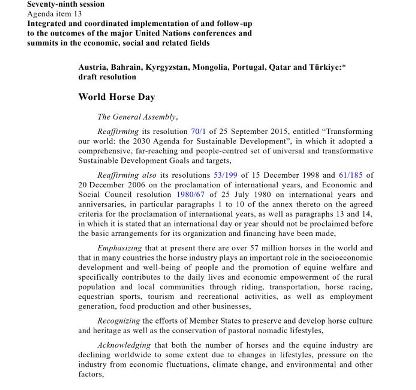
The draft Resolution (document A/79/L.89), adopted by a recorded vote of 169 in favor to 1 against, with no abstentions, invites Member States and other stakeholders to observe the Day every year, through activities aimed at raising awareness about the economic and social importance of the horse and the equine industry.

Introducing the draft Resolution, the representative of Mongolia described the horse as “one of the most important animals in human history” and pointed to its role in transportation, agriculture, farming, and mining, as well as recreational fields such as horse-racing and tourism.  But the number of horses, horse breeds, and the horse industry are declining due to changes in lifestyles, technological advancements, economic fluctuations, and environmental factors.  Highlighting the sacred place that horses hold in his country’s pastoral nomadic culture, he said that it has one of the largest horse populations in the world.  The text aims to encourage concrete actions to support the equine industry and conserve equine cultural heritage.
Join us on social media!

Article translations:

Related Article

Оби зулол
Оби зулол

Most Read

Recent Articles

The only GPW veteran in Dushanbe allocated more than 80,000 somoni

The mayor's office of Dushanbe allocated him 25,000 somoni.

GITEX AI Kazakhstan 2026: how Almaty became the main AI hub of Central Asia

More than 300 companies and startups, over 200 speakers and 100 investors from 50 countries — the region is entering the global stage.

A trade and economic park to be built at the border junction of Tajikistan, Kyrgyzstan, and Uzbekistan

President of the Kyrgyz Republic Sadyr Japarov familiarized himself with the project.

A project to protect soil from degradation to be developed in Central Asia

The initiative is of great significance for the mountainous countries of the region, including Tajikistan.

Mudslide, death, and destroyed homes: hundreds of families in Tajikistan left homeless

A correspondent from "Asia-Plus" visited Kulob and spoke with the families of those who died and were affected by the disaster.

Spring 2026 bright event: new issue of VIPzone now on sale

This issue is about people and ideas that change everything: from business and investments to fashion, food, and urban environment.

Godfrey Sullivan: “Tajikistan is a promising market for Visa to develop digital payments”

The Vice President of Visa explained why Tajikistan is becoming a promising market for digital payments and how artificial intelligence is influencing the future of finance.

Seven students in Dushanbe were threatened with expulsion for arriving at universities in personal cars

The materials for each case have been sent to the Ministry of Education and Science for appropriate actions.

India’s blockchain push and lessons for the global south

The Indian Government has started pushing aggressively its agenda...

India’s blockchain push and lessons for the global south

The Indian Government has started pushing aggressively its agenda...