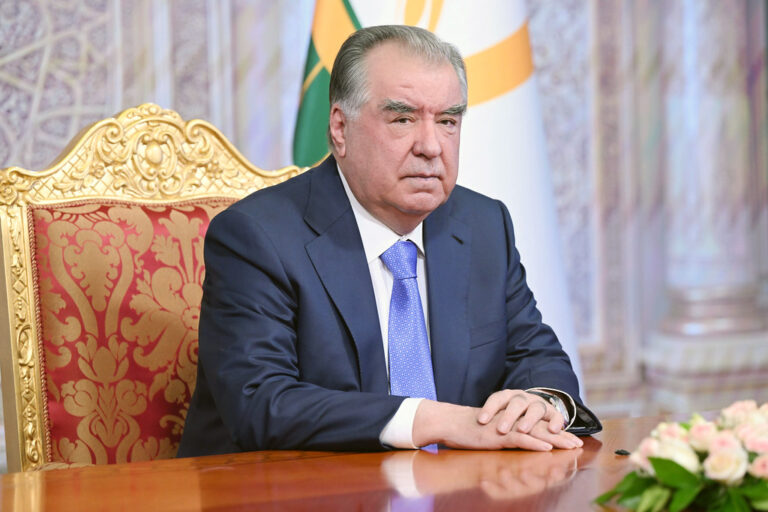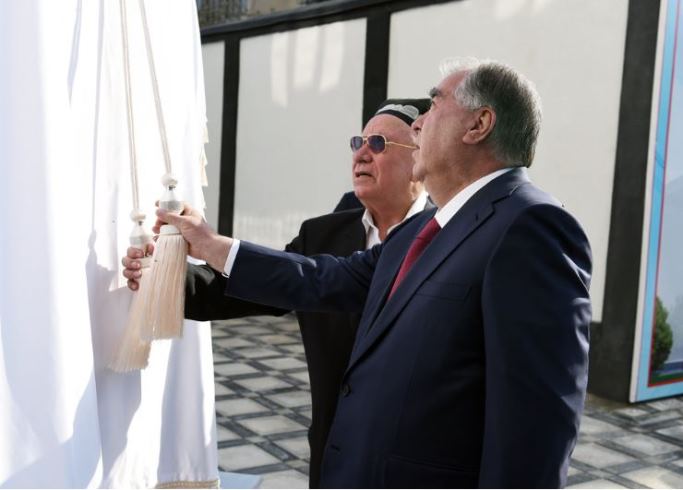
President Emomali Rahmon began his working tour of the Khatlon region on October 22 with a visit to Vose district, where he inaugurated a series of major social and economic facilities aimed at boosting local infrastructure and services.
The Tajik president’s official website says that among the highlights of the visit was the official opening of the newly constructed Hulbuk Medical Diagnostic Center — an eight-story facility equipped with state-of-the-art medical technology. Funded by local entrepreneur Rajabali Mirzoaliyev at a cost of 20 million somonis, the center is designed to improve healthcare services in the district. It features nine consulting rooms on the first floor, including specialized services in internal medicine, neurology, ENT, gynecology, cardiology, and women's health diagnostics. The center currently employs 40 medical professionals, the majority of whom are local women.
President Rahmon also inaugurated the Central Stadium of Vose, a 21,000-seat facility constructed to support the growth of football and other sports in the region. Built by the Directorate for the Construction of Government Facilities under the Executive Office of the President, the stadium's construction began in 2017 and was completed at a cost of approximately 69 million somonis. The project aligns with Tajikistan's National Football Development Program for 2022–2026, which includes plans for 130 new sports facilities across Khatlon.
In addition to these flagship projects, the president remotely launched several new institutions, including language training and service centers, schools, preschools, sports halls, and industrial enterprises. He also laid foundation stones for future developments.
The visit also saw the opening of a Vocational Training and Service Center under the Ministry of Labor, Migration, and Employment. Built under a grant agreement between the Tajik government and the Asian Development Bank (ADB), the center was completed in less than a year and occupies over 25 acres. It is part of a national initiative to improve vocational skills and employment prospects across the country.
President Rahmon reviewed a residential development project featuring multi-story apartment buildings with integrated service and retail spaces. The planned buildings will be nine stories high and include modern design features. Preschools and commercial outlets will occupy the first two floors.
Later in the day, the president inaugurated the Durdona sewing factory and service center in the village of Selbur, Miraliobod rural community. Built by entrepreneur Davlatshoh Qahhorov at a cost of 3.35 million somonis, the facility is expected to contribute to local job creation, particularly for women.
The day's events concluded with the commissioning of a new paved and illuminated road in the village of Zarkamar, Miraliobod. The road, constructed with contributions from local residents and business owners, cost more than 2 million somonis.