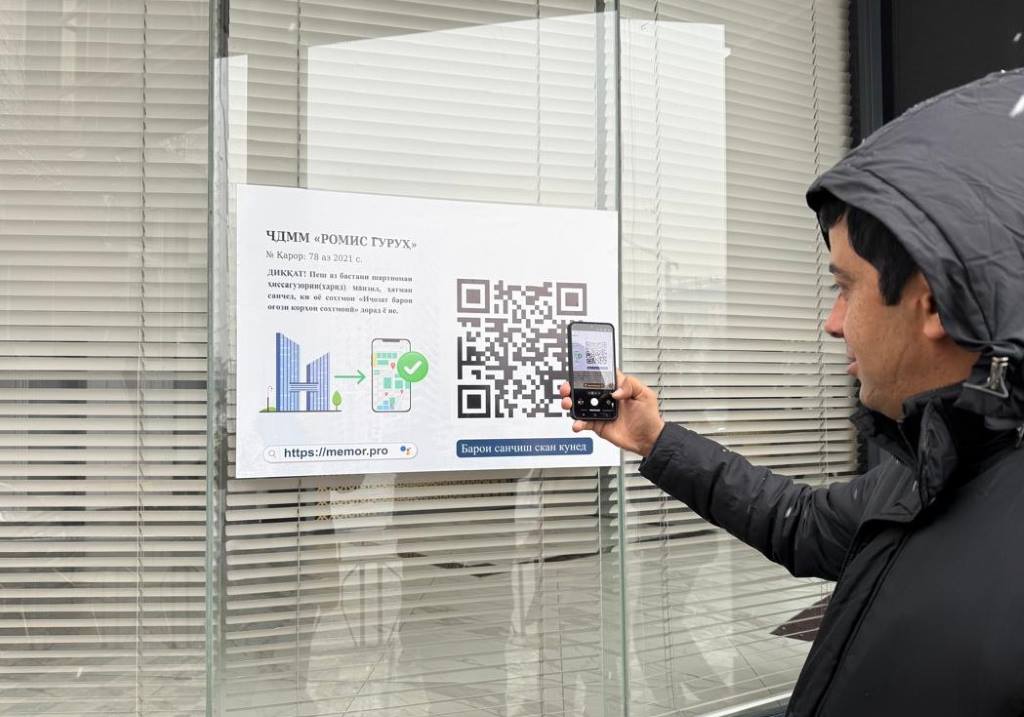
QR (quick response) codes have been installed on construction fences and at sales office entrances of residential complexes across Dushanbe, allowing citizens to verify crucial details about real estate projects — from the identity of the developer to official construction permits. This was confirmed by the city's Main Directorate of Architecture in a statement to Asia-Plus.
A QR code is a 2D barcode, a square grid of black and white pixels that stores data like URLs, text, or contact info, allowing instant access via a smartphone camera. Invented by Denso Wave for logistics, they offer rapid data retrieval, higher capacity than traditional barcodes, and even some damage tolerance. You scan them with your phone's camera, which decodes the pattern into usable information, making them popular for marketing, payments, and information sharing.
By scanning the QR code with a mobile phone, users are directed to the unified online platform www.memor.pro, which provides comprehensive information about high-rise construction in the capital. The initiative aims to digitize urban development, increase transparency, and protect the rights of homebuyers.
"Many residential complexes are marketed under attractive commercial names that can mislead buyers. The new system enables people to identify the actual legal entity (LLC) responsible for the project," an official source within the Dushanbe Main Directorate of Architecture told Asia-Plus in an interview.
What information is available via the QR Code
The system provides automatic access to six key construction-related documents:
· Design approval;
· General layout plan;
· Building passport;
· Expert review conclusion;
· Construction permit;
· License for construction activity.
Users can also view a list of relevant permits and confirm whether the building is part of the approved urban development plan. In addition, contact details of responsible parties are available, ensuring direct communication between the buyer and the developer.
If a project is not found in the system, it means there is no official authorization for construction.
How the system works
Upon scanning a QR code, the system connects to the www.memor.pro portal and displays the current status of the building. A color-coded system is used for clarity: green indicates that all documentation is complete and in order; red warns that pre-construction paperwork is incomplete, and signing a shared ownership contract is not recommended.
According to Bahrom Mahmadali, First Deputy Head of Dushanbe’s Main Directorate of Architecture, this initiative is part of the mayor's policy to strengthen trust between the public and the construction sector.
The architecture authority strongly advises residents to check a building’s legal status before purchasing property. Given the frequent cases of real estate fraud in the capital, this measure is expected to help better protect buyers’ rights.