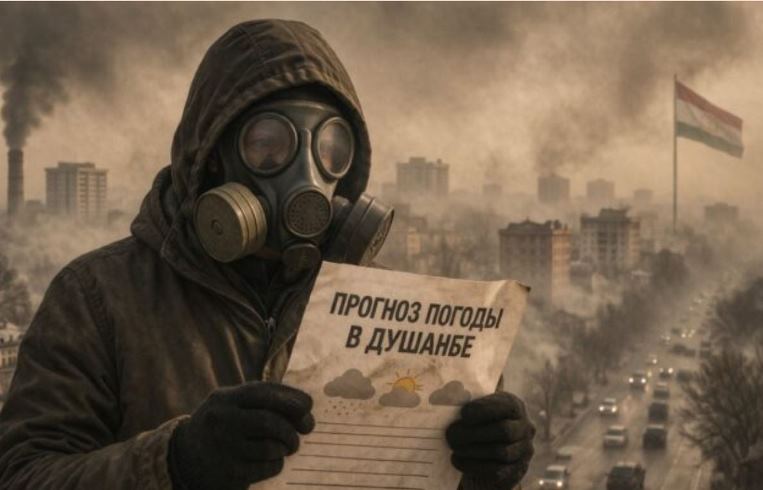
Tajikistan has once again found itself among the countries with the most polluted air in the world.
According to the "2025 World Air Quality Report" by the international organization IQAir, Tajikistan ranks third globally for air pollution, behind only Pakistan and Bangladesh. Environmentalists warn that if nothing changes, by 2040, air pollution levels in Dushanbe could rise by 50%.
More monitoring, less clean air
In 2025, IQAir analyzed data from 9,446 monitoring stations across 143 countries and territories. Twelve new countries were included in the report for the first time, indicating that air quality monitoring is becoming more widespread and accurate. However, the data shows that air quality is not improving. Only 14% of cities globally meet the World Health Organization's annual PM2.5 level recommendations, a decrease from the previous year.
Top 5 countries with the most polluted air:
1. Pakistan
2. Bangladesh
3. Tajikistan
4. Chad
5. Democratic Republic of the Congo
The closure of the air quality monitoring program at US embassies and consulates in 2025, which provided independent data in 44 countries, has further exacerbated the problem, leaving six countries without any monitoring.
Dushanbe: breathing is becoming harder
In 2025, the annual average concentration of PM2.5 in Tajikistan reached 57.3 µg/m³, which is 11.4 times higher than the World Health Organization's recommended level. This is also worse than the 2023 figure of 49.1 µg/m³, indicating a worsening trend.
Dushanbe remains one of the most polluted cities in the region. According to the World Bank, the PM2.5 levels in the city have consistently stayed above 50 µg/m³ in recent years.
Causes of air pollution in Dushanbe
Air pollution in Dushanbe is highly seasonal. In winter, the concentration of harmful particles increases due to the heating season, when the use of coal and wood for heating rises.
In summer, dust becomes the main contributor to pollution, accounting for up to 70% of total pollutants according to some estimates.
What pollutes the air:
· 42% – Heating of private homes with wood and coal
· 15% – Transport
· 12% – Burning of waste
· 25% – Dust from construction and natural sources
What needs to change?
Environmentalists and experts urge the authorities to take decisive action. Timur Idrisov, co-founder of the "Medvezhiy Ugol" initiative group, believes that it is essential not only to expand the monitoring network but also to rethink urban planning, energy efficiency, and emissions control approaches. "Without this, even the most modern air quality data won't solve the problem," said Idrisov.
Key recommendations include aligning national pollution standards with World Health Organization standards, as the current permissible concentrations in Tajikistan are significantly higher than international norms.
Experts also propose expanding the government’s monitoring system and installing automated stations in cities with open access to data. Supporting public monitoring through affordable air quality sensors will help citizens see real-time data.
What else needs to be done?
Emissions can be reduced by modernizing thermal power plants and industrial enterprises, as well as implementing the "polluter pays" principle. A significant step would be the development of eco-friendly transportation, including public transport, cycling infrastructure, and car-free zones. Improving the energy efficiency of buildings would also reduce the use of coal and other fuels during the heating season.
Green initiatives, such as creating parks, squares, and planting greenery along roads and near industrial sites, will also significantly improve air quality.
The future and consequences without change
According to the World Bank, if the situation remains unchanged, air pollution levels in Dushanbe could increase by 50% by 2040. Emissions of major pollutants such as SO2 and NOx could rise by 33% and 70%, respectively, while PM2.5 concentrations could reach 77 µg/m³.
However, experts believe that with comprehensive measures, the situation can be radically changed. The key is decisive action from the authorities to improve the environmental situation.