DUSHANBE, November 29, 2012, Asia-Plus — The Tajik authorities reportedly intend to introduce the practice of holding public hearings to discuss local budgets.
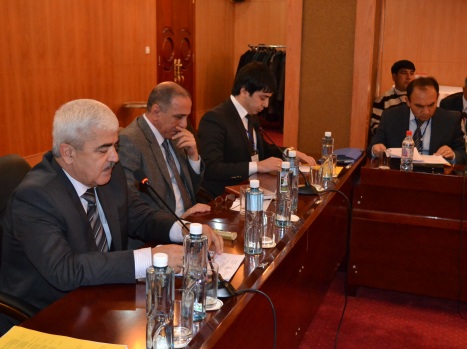
Davlat Elnazarov, deputy head of the inter-budgetary relations department within the Ministry of Finance (MoF), remarked this in Dushanbe on November 29 while delivering a statement at an international conference formally titled “Budget Transparency in Tajikistan: Formation and Experience of Other Countries.”
“To-date, the practice of public hearings to discuss local budgets has been introduced in six cities and districts across the country – Qairoqqum, Sarband, Hisor, Roghun, Jabborrasoulov, and Jilikul,” he noted.
According to him, they are currently developing instructions on holding the public hearings and introducing the budget transparency practice across the whole Tajikistan. “We believe that this practice will give an opportunity to efficiently spend the narrow means of local budgets,” Elnazarov added.
“The population is not yet aware well of what the budget is and how it is distributed,” noted Kamol Obidov, program director, Tajik Branch of Open Society Institute/Assistance Foundation (OSI/AF-Tajikistan). “People must understand what the public hearings are needed for and what this discussion may give. In pilot districts, we have conducted training seminars for local authorities on methods of introducing the budget transparency.”
Organized by local NGO Center for Municipal Development under support of OSI/AF-Tajikistan, the conference reportedly brought together representatives of local authorities from six pilot cities and districts and experts from Kyrgyzstan and Georgia.
This conference is the completion phase of the project, Support to Local Budget Transparency, sponsored by the OSI East-East Program. The Center for Public Technologies from Kyrgyzstan and Caucasian Institute for Social and Economic Research from Georgia have also participated in implementation of this project.
It is t be noted that there has been a civil society movement, particularly in developed countries in recent years to improve transparency in budget processes. A number of developing countries have also enacted legislations to enhance public access to budget information. These government efforts have been aided by a number of international transparency standards developed to provide benchmarks for government performance. The International Monetary Fund (IMF)’s Code of Good Practices on Fiscal Transparency, in particular, provides a set of guidelines to establish a sound and viable transparency framework for fiscal policy and has the following objectives: clarity of roles and responsibilities in public finance; public availability of information; open budget preparation, execution and reporting; and independent assurances of integrity such as for e.g. through external audit.
Lack of access to relevant budget information is the first challenge often faced by civil society organizations (CSOs) seeking to analyze or influence budget processes. Therefore, efforts to gain access to financial information or campaigning for increased budget transparency are often a first step budget work initiated by civil society organizations.