
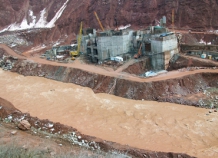
DUSHANBE, March 25, 2013, Asia-Plus — Uzbek Deputy Minister of Agriculture and Water Resources, Shavkat Hamrayev, questions the objectivity of assessment studies for the Roghun hydroelectricity project. He noted this in an interview with UN Radio on March 21.
According to him, the World Bank has given money for conducting assessment studies to Tajikistan and Tajikistan has chosen experts at its own discretion.
“We have repeatedly pointed to the necessity of taking into consideration the region’s geology, anthropogenic factors and trans-boundary water regime while conducting the environmental and social impact study for the project, but many our questions have remained unanswered,” Uzbek official noted.
“Since Uzbekistan has not got replies to these important questions, it cannot support the study findings,” Hamrayev said.
Uzbek official considers that it is necessary to discuss these issues and conduct independent international examination.
We will recall that in response to a request from the Government of Tajikistan, the World Bank has supported two Assessment Studies of the proposed Roghun HPP: the Techno-Economic Assessment Study (TEAS) and Environmental and Social Impact Assessment (ESIA). To ensure that the Studies address the concerns of government and civil society stakeholders and meet international quality standards, including expectations of transparency, the Bank has facilitated a process of information-sharing and discussion. The Bank has made no financial commitment to support construction of the Roghun HPP.
The World Bank held initial consultations with the governments of Kazakhstan, Kyrgyzstan, Tajikistan, Turkmenistan, Uzbekistan, and Afghanistan (Riparians) on the Terms of Reference for the Assessment Studies in 2008-2009. The Government of Tajikistan, with support from an International Development Association (IDA) loan, then contracted two consulting firms on an international competitive basis: Coyne & Bellier (TEAS) and Poyry (ESIA). The Bank also established two independent Panels of Experts (PoEs) to perform due diligence and ensure that the Studies conform to international quality standards.