
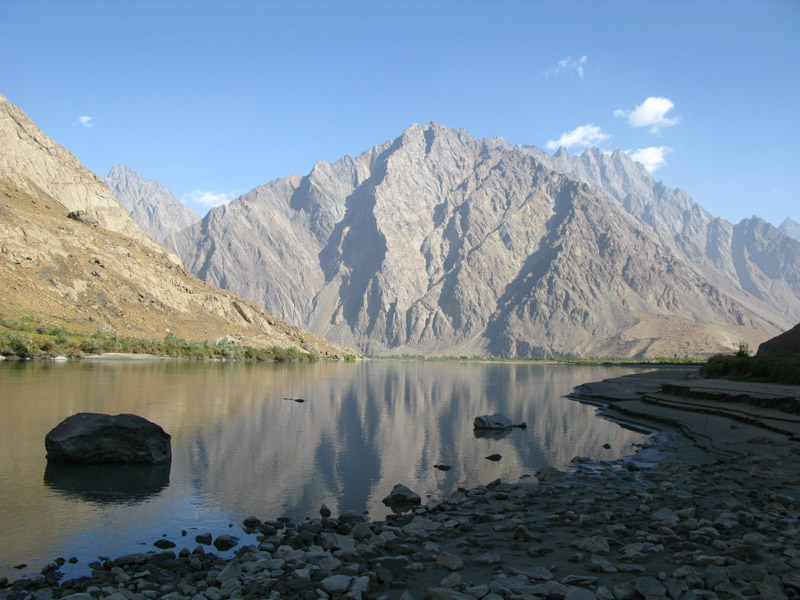
DUSHANBE, March 28, 2013, Asia-Plus — Afghan and Tajik officials responsible for water and environment management met in Dushanbe from March 25 to March 27 for the third bilateral meeting in the process to establish cooperation on hydrology and environment in the shared upper part of the Amu Darya River Basin, press release issued by the United Nations Economic Commission for Europe (UNECE) says.
Organized by the United Nations Economic Commission for Europe (UNECE) in cooperation with the Committee for Environmental Protection of Tajikistan, the meeting reportedly discussed the following challenges: adaptation to climate change; management of frequent and severe floods; provision of security for staff responsible for hydrological monitoring of the border of the two countries; and protection of vulnerable ecosystems.
Meeting participants, in particular, noted that in the face of these and other challenges, intensified cooperation would benefit both States as well as other riparian countries.
A bilateral working group was set up to pursue further joint work on hydrology as well as on the environment. A work plan was agreed that includes joint hydrological monitoring and exchange of information in the Panj River Basin, an upstream tributary to the Amu Darya that marks the border between Afghanistan and Tajikistan. A program for environmental cooperation was approved. The first meeting of the bilateral working group is scheduled to take place in Kabul in the autumn.
In an effort to improve the understanding of the shared river basin, A Visual Atlas of Cooperation, developed in cooperation with the Zoi Environment Network, was presented during the meeting.
A field visit was also organized along the Varzob River to study issues such as monitoring of water resources and protection of mountain ecosystems.
The meeting, held in the framework of the International Year for Water Cooperation, was chaired by Deputy Chair of the Tajik Committee for Environmental Protection Oihon Sharipova. The Afghan Ministry for Foreign Affairs, as well as agricultural, water and environment authorities in Kabul and regions neighboring Tajikistan, were represented at the meeting.
The project is part of the work program of the UNECE Convention on the Protection and Use of Trans-boundary Watercourses and International Lakes, as well as the United Nations Special Program for the Economies of Central Asia.
The project “Strengthening Cooperation on Hydrology and Environment between Afghanistan and Tajikistan in the Upper Amu Darya River Basin” supports Afghanistan and Tajikistan in the development of hydrology and environment cooperation in the basin. The Ministry for Water and Energy and the National Environmental Protection Agency of Afghanistan and the Committee for Environmental Protection of Tajikistan and Tajik Hydromet are project partners. On the basis of existing bilateral agreements the two countries will strengthen their cooperation and information exchange. The Russian Federation and UNECE provide funding for the project.
The objective of the project is to support the establishment of long-term cooperation between the two countries on hydrology and environment. The aim is also to improve the understanding of and access to information about the water resources and environmental conditions in the upper Amu Darya Basin for relevant stakeholders in the whole basin.
The 1992 UNECE Convention on the Protection and Use of Trans-boundary Watercourses and International Lakes (Water Convention) aims to strengthen national measures and trans-boundary cooperation for the protection and ecologically sound management of trans-boundary surface waters and ground waters. Thirty-eight States and the European Union are Parties to the Water Convention. The Convention was amended in 2003 to open it to countries outside the UNECE region (including Afghanistan) to become Parties. The amendment entered into force on February 6, 2013. It is expected that non-UNECE countries would be able to join the Convention as of end 2013 – early 2014.
The Geneva based Zoi Environment Network is an international non-profit organization with a focus to visualize environmental issues and connections between the environment and society.
The Amu Darya River, shared by Afghanistan, Tajikistan, Turkmenistan and Uzbekistan, is one of the main rivers in Central Asia. It runs from the Pamir Mountains to the Aral Sea. The Panj, an upstream tributary of the river, constitutes the border between Afghanistan and Tajikistan.
