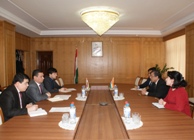
DUSHANBE, February 25, 2015, Asia-Plus — Tajik Minister of Economic Development and Trade Nematullo Hikmatullozoda yesterday met with Indian Ambassador to Tajikistan Asith Kumar Bhattacharjee.
The Ministry of Economic Development and Trade (MEDT) press center reports the two discussed state and prospects of further expansion of bilateral economic cooperation between Tajikistan and India.
“The sides discussed various aspects of bilateral economic cooperation, including India’s interest in a trilateral transit trade pact between Tajikistan, Afghanistan and Pakistan and holding of the next meeting of the Tajik-Indian commission for trade and economic cooperation,” the press center says.
A two-way trade between Tajikistan and India last year valued at 21 million U.S. dollars.
As far as the trilateral transit trade agreement between Tajikistan, Afghanistan and Pakistan is concerned, the three countries have agreed to prepare the draft trilateral transit trade agreement during the first quarter of this year.
Delegations of Tajikistan, Afghanistan and Pakistan met in Islamabad on January 3 to discuss the details the trilateral transit trade agreement and they reportedly decided to expedite the process of consultations to reach conclusive decisions on the agreement.
The Nation
(Pakistan) reported on January 4 that the three sides nominated their focal persons for technical discussions for the agreement and agreed to meet in February in Dushanbe with first draft of the trilateral transit trade agreement. The meeting also expressed its consensus to bring the final draft of agreement in March, which may be signed in Kabul, according to
The Nation
.
We will recall that Afghanistan and Pakistan signed a memorandum of understanding (MoU) for the Afghan-Pak trade transit agreement (APTTA) in July 2010. In October 2010, the landmark APTTA agreement was signed. The APTTA allows Afghan trucks to drive inside Pakistan to the Waqah border with India, including to the port cities of Karachi and Gwadar.
In November 2010, the two states formed a joint chamber of commerce. The APTTA agreement has taken effect after several Afghan trucks delivered fruits from Afghanistan to the Waqah border with India in June 2011. With the completion of the APTTA, the United States and other NATO states are planning to revive the ancient Silk Road. This is to help the local economies of Afghanistan and Pakistan by connecting South Asia with Central Asia and the Middle East.
In July 2012, Afghanistan and Pakistan agreed to extend APTTA to Tajikistan in what will be the first step for the establishment of a North-South trade corridor. The proposed agreement will provide facilities to Tajikistan to use Pakistan’s Gwadar and Karachi ports for its imports and exports while Pakistan will enjoy trade with Tajikistan under terms similar to the transit arrangement with Afghanistan.