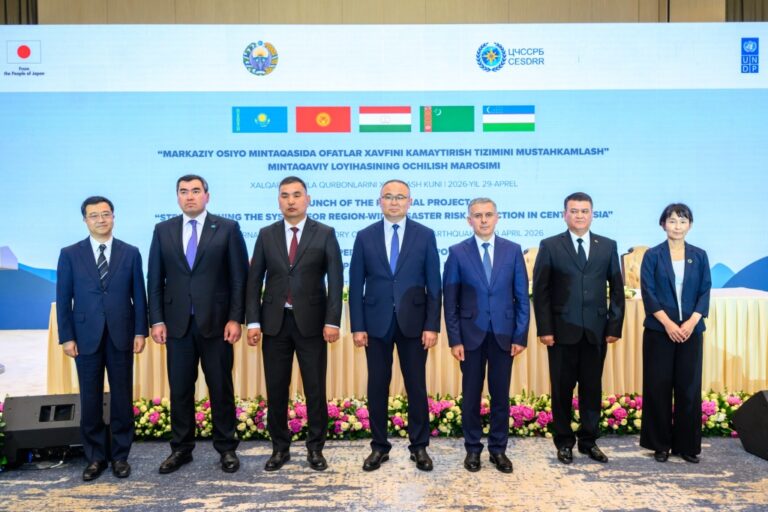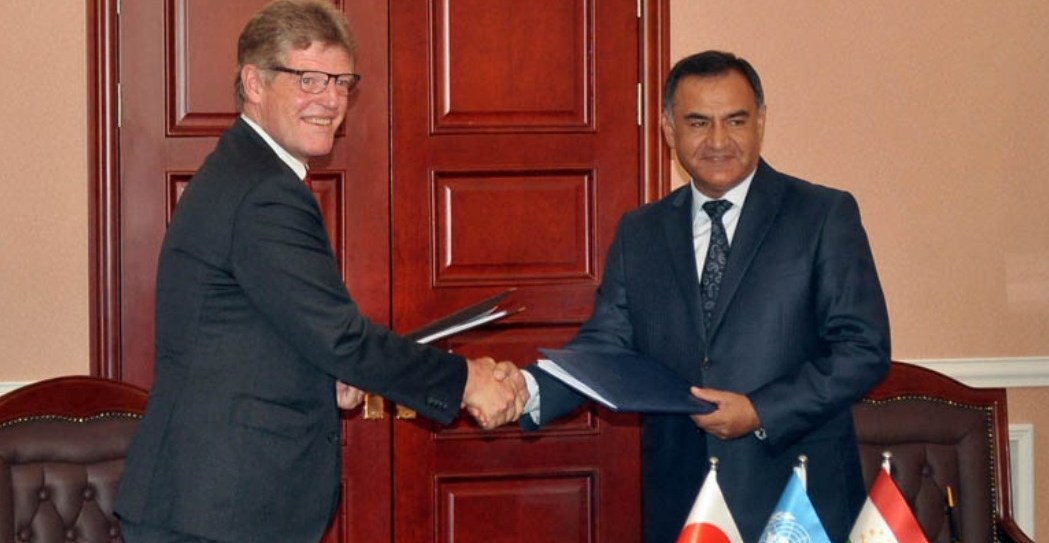
The four-year project of “Capacities strengthening in disaster risk reduction and response in Tajikistan” was signed in Dushanbe between the Committee of emergency situations and civil defense under the government of Tajikistan, United Nations development Program (UNDP) and the government of Japan.
The signing ceremony, which was held in the Ministry of Foreign Affairs of the Republic of Tajikistan, was attended by the Minister of Foreign Affairs Sirojiddin Aslov, the head of CoES and Civil Defense Rustam Nazarzoda, Ambassador Extraordinary and Plenipotentiary of Japan in the Republic of Tajikistan Mr. Hajime Kitaoka and alternate Country director of UNDP in Tajikistan Jan Harfst.
This project was developed on the basis of the National strategy for disaster risk management and in the framework of realization the “Sendai framework for disaster risk reduction” and is funded by the government of Japan. The project duration is 48 months. The construction of it is more than 10.5 million U.S. dollars.
The project is aimed at helping to improve the planning of management measures in emergency situations, preparedness and response in nine districts, including three areas, located near Afghan border, and to strengthen the capacity of search and rescue teams.
It was noted that the project will contribute to the development of cross-border cooperation with Afghanistan, to improve disaster response in accordance with the appeal made by the participants of the dialogue "Central Asia plus Japan" and will provide an opportunity to further develop regional cooperation in the field of disaster risk reduction.
In his speech, Mr. Kitaoka stated that the signing of the project will open new milestone of partnership between Japan, Tajikistan and UNDP and “will further strengthen our ties and friendly relations”.
"It is gratifying that on the eve of the celebration of the 25th anniversary of the state independence of our country we have signed another important document, which is a continuation of realization of the state policy of the Republic of Tajikistan in the sphere of emergency situations and risk reduction from natural disasters. Of course, it is a factor for the strengthening and development of international cooperation between our countries and UNDP," – said the head of CoES Rustam Nazarzoda.