
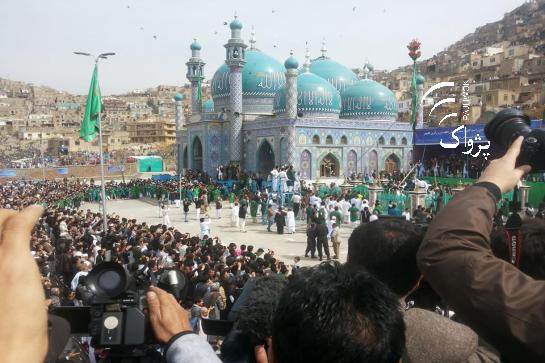
At least 14 people have been killed in an attack on a shrine in the Afghan capital, Kabul as Shia Muslims prepared for a religious day of mourning.
Associated Press reports that on one of the most holy days of the Shia-Muslim calendar, Shia pilgrims were reportedly the target of three gunmen who entered the Kart-e Sakhi Mosque in the Afghan capital Kabul yesterday and killed at least 14 people and wounded 26 others.
Shi'ite mourners had gathered near the shrine to celebrate the Day of Ashura, one of the holiest on the Shi'ite calendar.
One of the dead was a police officer, Sediq Sediqqi, a spokesperson for the Ministry of the Interior said.
Police special forces who responded to the scene found and killed only one gunman, the spokesman noted. Initial reports said three attackers were involved.
According to Radio Liberty, Ministry of Public Health officials said at least 43 people had been injured in the incident and had been taken to hospital. Officials expected the death toll to rise.
No group has claimed responsibility. In a statement, Taliban spokesman Zabiullah Mujahid said the group did not carry out the attack.
In a statement issued on October 11, Afghan President Ashraf Ghani offered condolences to the victims and condemned the attack as a “clear sign of a crime against humanity.”
In July, an attack claimed by Islamic State (IS) extremists killed 84 people, many of them Shi'a from the ethnic minority Hazara group.
Ashura commemorates the death of Imam Husayn, grandson of the Prophet Muhammad, who was killed in 680 and whose death laid the foundation for the Shi'ite faith. For Shi'a Muslims around the world, Ashura is a symbol of the struggle against oppression.
Shia Muslims make up about 15% of Afghanistan's population, and many of them come from the Hazara ethnic group.
Ashura (Day of Remembrance) is the tenth day of Muharram in the Islamic calendar. For Shi'a Muslims, Ashura marks the climax of the Remembrance of Muharram, and commemorates the death of Husayn ibn Ali, the grandson of Muhammad at the Battle of Karbala on 10 Muharram in the year 61 AH (October 10, 680 CE). The massacre of Husayn with a small group of his companions and family members had a great impact on the religious conscience of Muslims, particularly Shia Muslims, who commemorate Husayn's death with sorrow and passion. Mourning for Husayn and his companions began almost immediately after the Battle of Karbala by his surviving relatives and supporters. Popular elegies were made by poets to commemorate the Battle of Karbala during the Umayyad and Abbasid era, and the earliest public mourning rituals occurred in 963 CE during the Buyid dynasty. In Afghanistan, Iran, Iraq, Lebanon, Bahrain, and Pakistan, the Commemoration of Husayn ibn Ali has become a national holiday and most ethnic and religious communities participate in it.