Kazakh president sets his country’s priorities as UN Security Council member

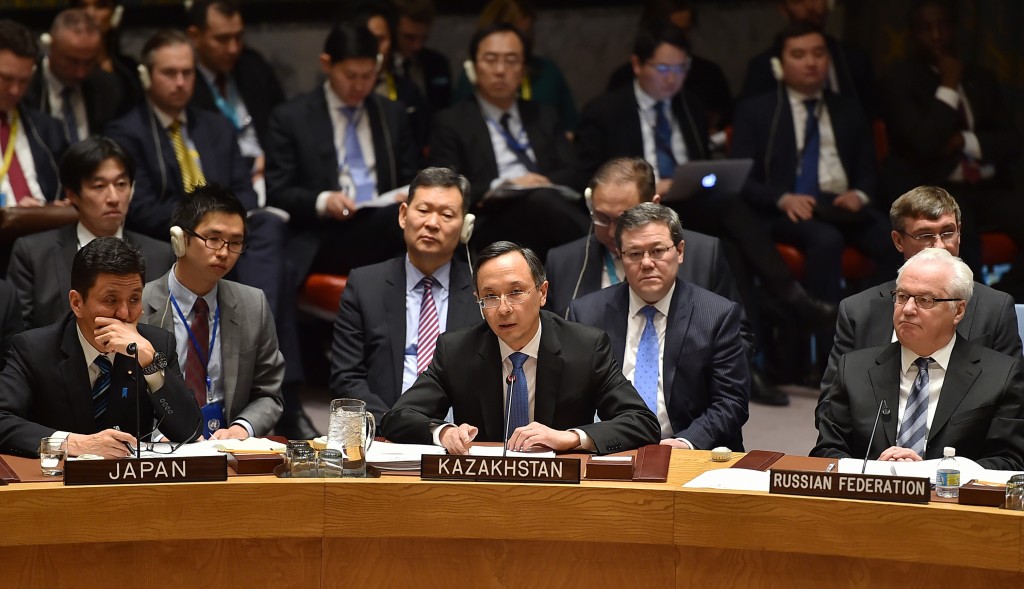
On Tuesday January 10, Kazakhstan as a non-permanent member of the UN Security Council for the first time participated in its Open Debate on Conflict Prevention and Sustaining Peace, where Kazakh Foreign Minister Kairat Abdrakhmanov presented President Nursultan Nazarbayev’s policy address to UNSC members. On January 1, Kazakhstan became the first of Central Asia’s nations […]

Asia-Plus

On Tuesday January 10, Kazakhstan as a non-permanent member of the UN Security Council for the first time participated in its Open Debate on Conflict Prevention and Sustaining Peace, where Kazakh Foreign Minister Kairat Abdrakhmanov presented President Nursultan Nazarbayev’s policy address to UNSC members.

On January 1, Kazakhstan became the first of Central Asia’s nations he five to hold a seat on the 15-nation council.  Its permanent members are the United States, Russia, China, Britain, and France.

Kazakh media reports say that presenting Nazarbayev’s address on the occasion of the beginning of Kazakhstan’s duties as a non-permanent member of the UNSC for 2017-2018, Abdrakhmanov highlighted that the appeal was based on the principles of the Kazakh President’s earlier Manifesto “The World. The 21st Century.”

The new document, “Kazakhstan’s Concept Vision on Sustaining Global Partnership for Secure, Just and Prosperous World,” heavily stresses the need for joint efforts and cooperation in strengthening international peace and security.

In his address, President Nazarbayev said that Astana intends to “work on an equal basis with all Security Council members to promote compromise and consensus” to help strengthen international peace and security, the address reads in its direct appeal to UNSC members.

According to Nazarbayev, “Kazakhstan will work in a balanced and unbiased manner on the council’s entire agenda keeping in mind the paramount importance of maintaining and strengthening peace and security.”

In this regard, the address identifies some of Astana’s priorities in its work as a non-permanent member of the UNSC.  Among them are: moving towards a world free of nuclear weapons, preventing the threat of global war, promoting peace in Afghanistan and creating a regional peace zone in Central Asia, shaping a global antiterrorist coalition (network) under the auspices of the UN, promoting the peaceful development of Africa, adapting the UNSC’s activities to the demands of the 21st century and elaborating a set-up for regular meetings of UNSC member states at the level of heads of state and governments to strengthen a collective political will to address global challenges. 
Join us on social media!

Article translations:

Related Article

Оби зулол
Оби зулол

Most Read

Recent Articles

India’s blockchain push and lessons for the global south

The Indian Government has started pushing aggressively its agenda of embracing blockchain technology, and the same has received a new lease of life with...

India’s blockchain push and lessons for the global south

The Indian Government has started pushing aggressively its agenda...

25 Years in Touch: On Generation Change, “Digital” and “Invisible” Work

In its 25th anniversary year, "MegaFon Tajikistan" summarizes its...

The number of entrepreneurs in Tajikistan increases by 4.3%

The number of entrepreneurs operating under a patent is increasing the fastest.

Trump announces “very good” talks with Iran and the possibility of a quick agreement. Tehran did not comment on this

The President of the United States claims that Tehran has agreed to the US demand to abandon the development of nuclear weapons.

Police report the discovery of the remains of a man who had been missing since December 2025

A friend of the murdered person has been detained on suspicion of particularly brutal murder.

Residents of a settlement in Sughd: “Afghan refugees have disappeared from the Dehmoy jamoat”

Earlier, a citizen of Afghanistan was detained on charges of murdering a resident of Khujand.

In Russia, it was proposed to revoke residence permits and temporary residence permits from migrants who do not work for more than two months

During January-March 2026, 90% more residence permits were revoked from migrants in the country compared to the same period last year.

From reach to influence: why advertising no longer works by old rules discussed in Dushanbe

Market research forces a complete reconsideration of the advertising budget allocation strategy.