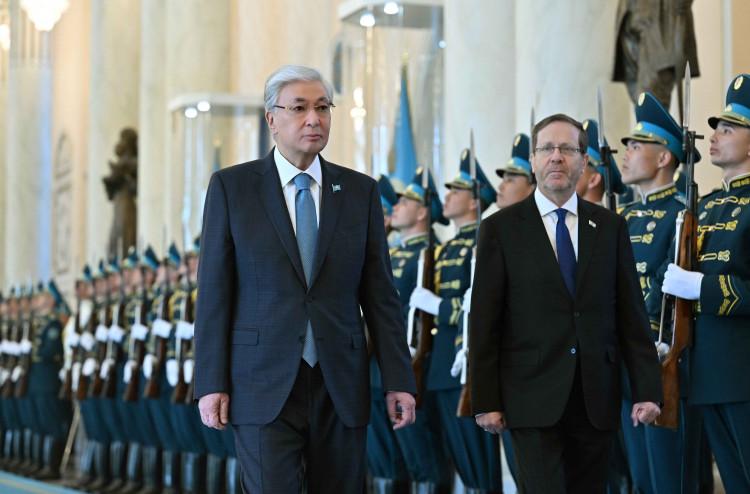
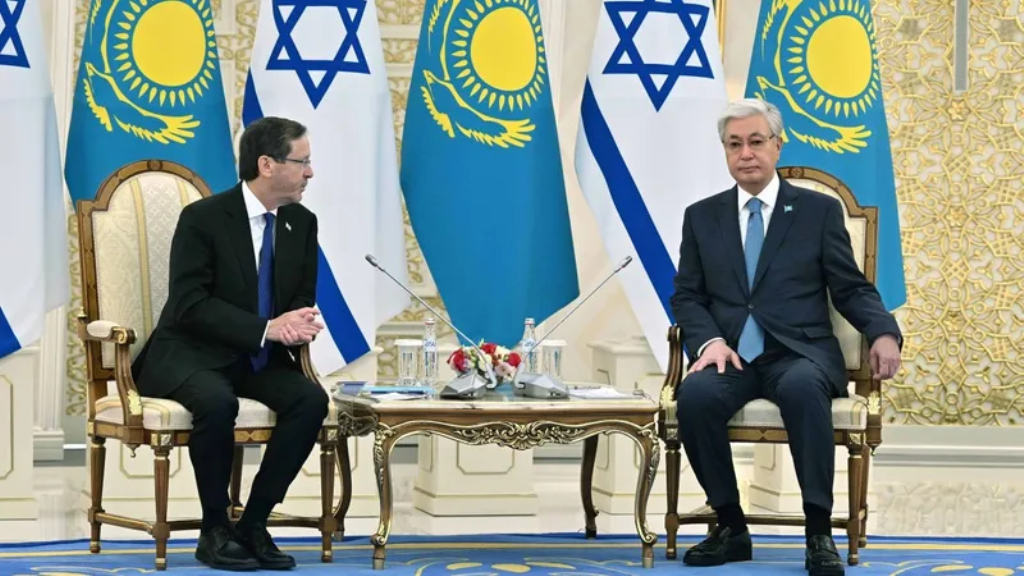
In Astana on April 27 an official meeting took place between Israeli President Isaac Herzog and Kazakh President Kassym-Jomart Tokayev.
The visit of the Israeli president to Kazakhstan occurs against the backdrop of a sharp escalation in the Middle East and is perceived as politically symbolic: Kazakhstan is increasingly strengthening ties with Israeli diplomacy, while Israel is simultaneously engaged in military operations on several fronts, Fergana news agency reports.
In recent months, cooperation between the two states has noticeably accelerated. In January 2026, Israeli Foreign Minister Gideon Sa’ar visited Astana for the first time in 16 years, where the parties signed an agreement on visa waiver.
Earlier, in November 2025, Kazakhstan announced its intention to join the “Abraham Accords” — a set of agreements to normalize relations between Israel and a number of countries with U.S. mediation. This decision was the result of telephone negotiations between Tokayev, Donald Trump, and Benjamin Netanyahu.
The current visit takes place against the backdrop of an extremely tense regional situation. In April 2026, the first direct negotiations in 34 years between Israel and Lebanon took place in Washington with U.S. mediation. Key issues remain the presence of Israeli troops on Lebanese territory and renewed Hezbollah attacks on northern Israel.
At the same time, attempts to resume dialogue between the U.S. and Iran continue, but negotiations in Islamabad have reached an impasse: Tehran rejected American proposals, deeming them unacceptable, while Iran’s weakened military structures maintain influence through the threat of closing the Strait of Hormuz.
From the perspective of international diplomacy, Herzog’s visit to Astana carries several signals. Kazakhstan — a major Muslim state, a member of the SCO, and a partner of both Russia and China — shows readiness to expand interaction with Israel. This allows Israel and the U.S. to demonstrate that the process of normalizing relations continues even amid the war in Gaza. In January, the possible participation of Kazakhstan in the “Gaza Peace Council,” promoted by Washington as an alternative to direct governance of the sector, was also discussed.
“Kazakhstan is a great country with a bright future, and Israel wants to be part of that future,” Herzog said during the meeting with Tokayev.
For Kazakhstan, deepening cooperation with Israel fits into the strategy of a multi-vector foreign policy. The country seeks to balance between various centers of power, and access to Israeli technologies, investments, and political channels in the U.S. represents significant value for Astana.
At the same time, such a course evokes a mixed reaction: part of society is critical of rapprochement with Israel amid conflicts in Gaza and Lebanon, and some regional players, including Iran and Turkey, view the “Abraham Accords” with caution.
Thus, Isaac Herzog’s visit goes beyond a protocol event and becomes part of a broader strategy by Israel to expand diplomatic ties in conditions of military and political tension.
The choice of Kazakhstan as a venue underscores the growing role of Central Asia as a space where the interests of major global and regional players intersect.