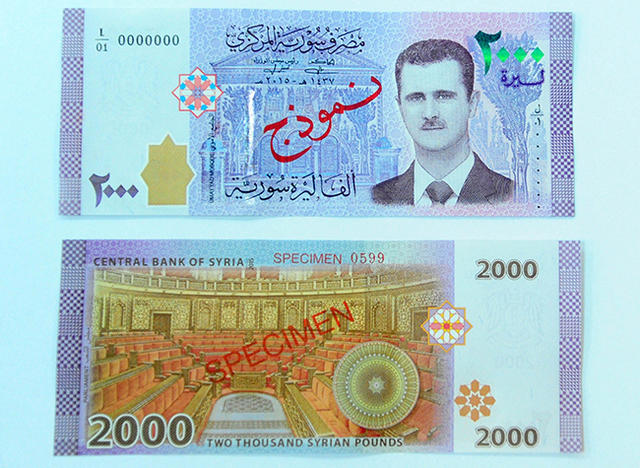
President Bashar al-Assad has appeared on the Syrian currency for the first time since taking office, with his portrait printed on a new 2,000-pound banknote ($3.9) that went into circulation on Sunday.
Citing wear and tear of the existing notes, Durgham said the time was right to put the new note into circulation, according to Al Jazeera.
Assad has been president of Syria since 2000, when he succeeded his father, Hafez al-Assad. Trained as an ophthalmologist, Bashar al-Assad was initially seen as a potential reformer. However, he has since been accused of human rights violations. Since 2011, Syria has been locked in a brutal and intractable conflict.
In the past, Syria's banknotes have tended to feature Hafez al-Assad or historical figures or sites. The portraits on the banknotes have attracted considerable attention in the past, given their political implications. In 2015, pro-government social media accounts urged a boycott of a new 1,000-pound bill after an image of Hafez al-Assad was removed from it.
The Washington Post says the introduction of the new 2,000-pound bill might seem to suggest economic weakness. The note is the highest denomination yet for the Syrian pound, a recognition that since the conflict in the country began, the value of the Syrian currency has dropped from about 47 pounds to the dollar in 2011 to more than 500 pounds to the dollar this year.
According to the official Syrian Arab News Agency (SANA), the Central Bank governor, Duraid Dergham, told reporters on Sunday that the plan for the 2,000-pound bill had actually been approved years ago but implemented only recently after exchange-rate fluctuations slowed down. Dergham also said that there was “no need to panic” that the bill could worsen the inflation.
According to The Washington Post, Steve Hanke, an economist at Johns Hopkins University who has closely followed Syrian inflation over the years, noted last month that the relatively stable pound suggested that Assad was in “control” of the country and its economy.