Researcher at the Institute of Economics and Demography of the Academy of Sciences, Fozil Fathulloyev, considers that imposition of Bedil’s poetry will throw Tajik society back.
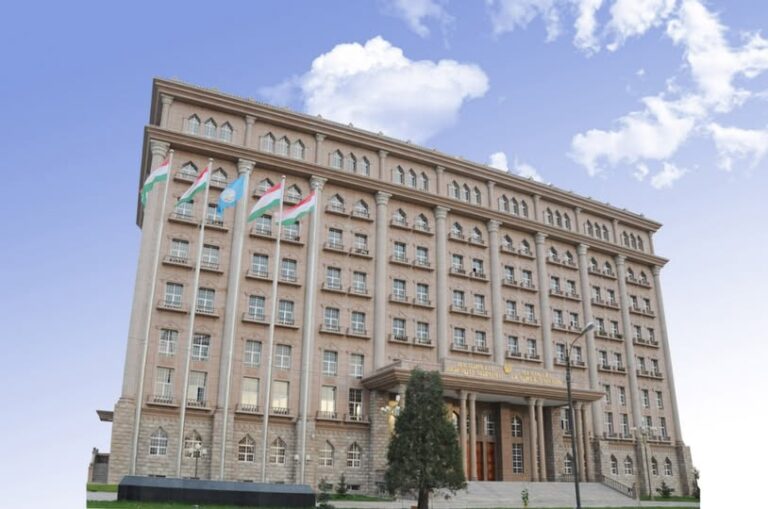
On December 5, the Academy of Sciences hosted a scientific conference dedicated to Mawlana Abul-Ma'anī Mirza Abdul-Qadir Bedil.
Fozil Fathulloyev also attended that conference.
After the conference, he wrote on his Facebook page that medieval poets like Bedil and their poetry will not help the Tajik people in the 21st century.
According to him, if Bedil’s poetry will be imposed on the people today, the society will be degraded. “I am proud that I don’t need Bedil’s verses even as a toilet paper,” Fathulloyev noted.
The Academy of Sciences notes that “worldview of young people such Fathulloyev is evidence of the fact that they hate history and culture of their people.”
According to the Academy of Sciences, Fozil Fathulloyev asked for forgiveness of the people of Tajikistan for his words and resigned voluntarily.
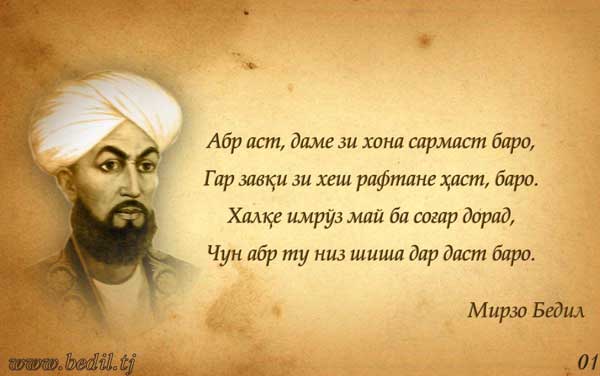
Mawlana Abul-Ma'anī Mirza Abdul-Qadir Bedil, also known as Bedil Dehlavī (1642–1720), was the foremost representative of the later phase of the “Indian style” (sabk-e hendi) of Persian poetry and the most difficult and challenging poet of that school. He is considered the most difficult and challenging poet of Safavid-Mughal poetry.
The Indian school of Persian poetry and especially Bedil's poetry is criticized for its complex and implicit meanings. The main reason could be his style which is kept a bit Indian.
Even though he is known as a master of Persian poetry, Bedil was actually of Turkic Central Asian descent, his family originally belonging to the Arlas tribe of the Chaghatay, regarded by some as part of the Uzbek people. He was born in Azimabad, present-day Patna in India.
Bedil mostly wrote Ghazal and Rubayee (quatrain) in Persian, the language of the Royal Court, which he had learned since childhood. He is the author of 16 books of poetry, which contain nearly 147,000 verses and include several masnavi in that language. He is considered as one of the prominent poets of Indian School of Poetry in Persian literature, and owns his unique Style in it. Both Mirza Ghalib and Iqbal-i Lahori were influenced by him.
Possibly as a result of being brought up in such a mixed religious environment, Bedil had considerably more tolerant views than his poetic contemporaries. He preferred free thought to accepting the established beliefs of his time, siding with the common people and rejecting the clergy who he often saw as corrupt.
Upon his emergence as a poet, Bedil gained recognition throughout the Iranian cultural continent, has been much welcomed in Afghanistan, Tajikistan and Pakistan. In Afghanistan, a unique school in poetry studying is dedicated to Bedil's poetry called Bīdelshenasi (Bedil studies) and those who have studied his poetry are called Bīdelshenas (Bedil expert). His poetry plays a major role in Indo-Persian classical music of Central Asia as well.