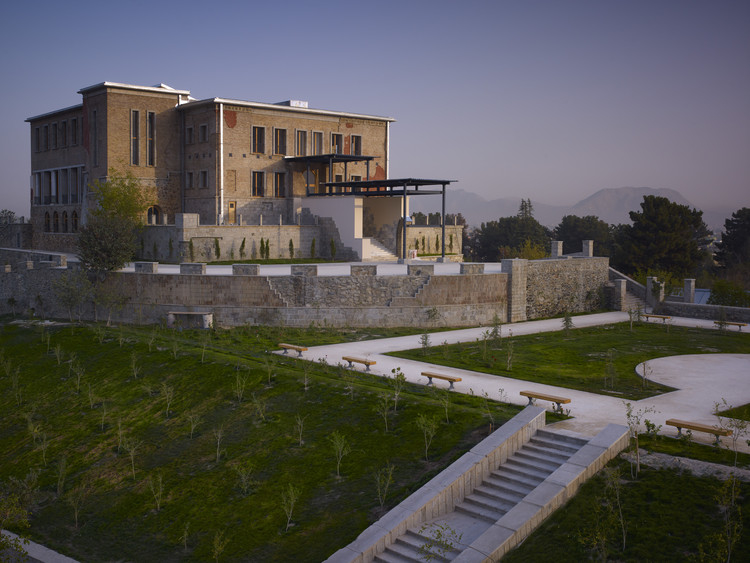
The Aga Khan Trust for Culture (AKTC) has recently restored the 12.5 hectare Chihilsitoon Garden in Kabul, Afghanistan.
Incorporating 10,200 square meters of modernized or newly constructed rammed earth buildings; the project now provides high-quality facilities for visitors, according to ARCHITECT.
Once a 19th century royal garden that was transformed into a state property that welcomed visiting dignitaries in the 20th century, Chihilsitoon was looted during the Afghan Civil War of the early 1990s and left in a severely damaged state.
Renovation work began in early 2015 and incorporated the existing sport and recreation facilities already on site. The landscaping was further enhanced through a network of formal paths and trails that link a variety of spatial experiences, including family picnic areas, an outdoor amphitheater, and the historic formal promenade, which features the original marble fountains.
The design of the new buildings, which include an exhibition hall, 300-seat auditorium, visitor management and administrative facilities, as well as a multi-purpose facility within the reconstructed palace, follows vernacular forms and typologies.
Traditionally used in parts of Afghanistan as far back as the second century AD, rammed earth, which was selected as the main building material, is highly suitable for the climatic and ecological environment of the region, said AKTC's in-house architects, who led the project. And because of the material's workability, a variety of architectural designs were explored for the various facilities.
Reinforced with bamboo trees, steel re-bar and concrete frame structures, the site's buildings were also constructed with rammed earth to withstand moderate earthquakes.
Throughout the site, more than 5,000 new trees were planted, while a commercial nursery was constructed in order to generate additional revenue for the upkeep of the site. Retail units, food kiosks and restaurants were also built into the park.
The renovation was delivered against a €15.1 million budget, provided by the German Federal Foreign Office through the KfW Development Bank. Funding the project also required extensive partnerships between local communities, Kabul Municipality and the Ministries of Culture and Urban Development.