Uzbekistan asks Iran for copy of page from rare Quran kept at the National Museum of Iran for museum.
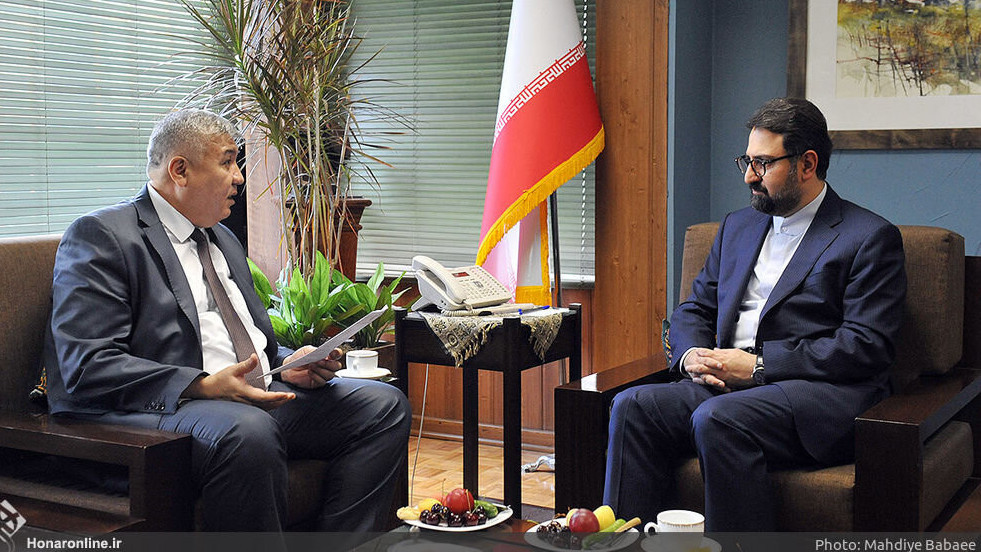
According to the Tehran Times, the request was made by Uzbekistan Ambassador Bakhodir Abdullaev at a meeting with Iran’s Deputy Culture Minister for Artistic Affairs Seyyed Mojtaba Hosseini in Tehran on July 9.
Calligraphy and illumination for this edition of the Quran was commissioned by Baysonqor Mirza (1399-1433), the grandson of Timur (1336-1405), the Turkic ruler of Central Asia.
The ambassador reportedly said that he wants an Iranian calligrapher to inscribe a page from the copy of the Quran for future display in a museum of Islamic civilization that his country plans to establish.
Hosseini said that his department would negotiate with the officials at the Cultural Heritage, Tourism and Handicrafts Organization (CHTHO) for the inscription of a page from the folio.
He added that several other rare manuscripts of the Holy Quran are being preserved at other museums and institutions of Iran.
The ambassador also said that Iranian musicians are frequent visitors to Uzbek festivals, and added that several Iranian groups have been invited to perform at the Sharq Taronalari International Music Festival taking place in Samarkand in August.
The Malek Museum and Library also keeps several pages of the rare manuscript of the Baysunqor Quran.
According to a study published by Columbia University in New York City, the Quran was first seen in modern times by traveler James Baillie Fraser in Quchan during a tour of Khorasan in 1821-2.
The pages had been taken to Quchan from Samarkand at the time of Nadir Shah’s occupation of the city in the 18th century. Part of the Quran had been placed in an imamzadeh in Quchan by a local Kurdish ruler who had participated in the campaign against Samarkand.
This imamzadeh was destroyed by an earthquake in 1895, but before this time, Qajar king Nasser ad-Din Shah had visited it and removed some of the pages to be placed in the library of the Golestan Palace in Tehran.
In 1912 Prince Mohammad Hashem Afshar visited Quchan and retrieved the remaining pages from the ruins, bringing some to Mashhad. Other pages and fragments are in Iranian and foreign collections, either brought from Samarkand at the time of its capture by Nadir Shah, taken from Quchan, or brought back as souvenirs before Nadir Shah looted the city.
Other pages are reportedly kept at the Astan Qods Library in Mashhad and the National Museum of Iran. The Reza Abbasi Museum in Tehran and the National Library and Archives of Iran has also fragments of the Quran.
Ghiyath ud-din Baysunghur, commonly known as Baysonqor or Baysongor, also called Sultan Baysongor Bahador Khan (1397 – 1433) was a prince from the house of Timurids. He was known as a patron of arts and architecture, the leading patron of the Persian miniature in Persia, commissioning the Baysonghor Shahnameh and other works, as well as being a prominent calligrapher.