Three party groups and one non-partisan group created in Tajikistan’s lower house of parliament

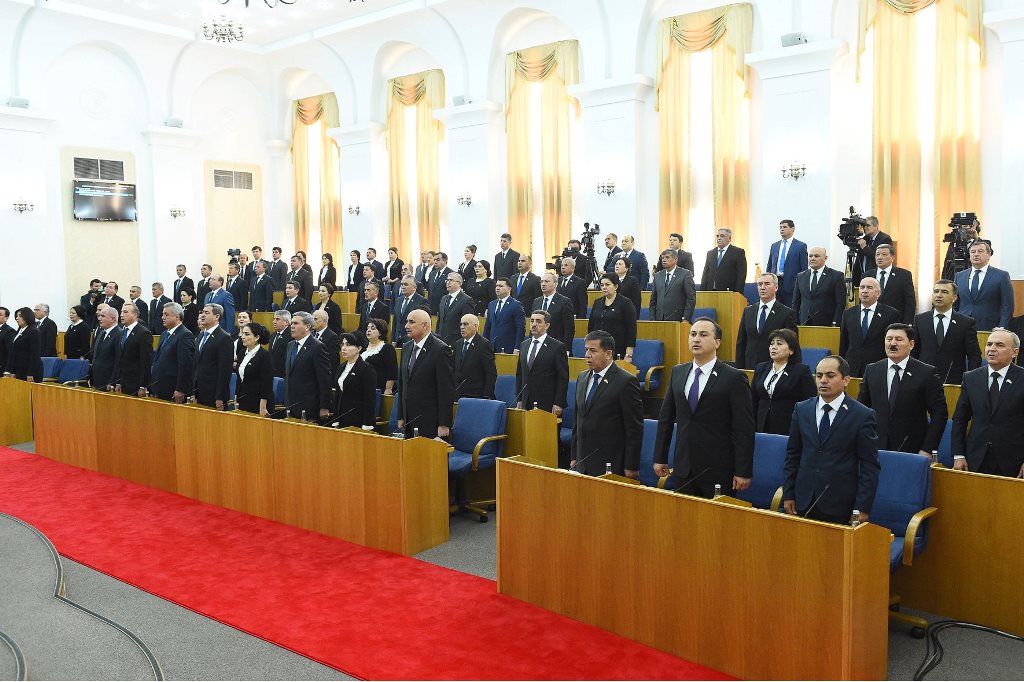
Tajikistan’s lower chamber (Majlisi Namoyandagon) has registered three party groups and one group of non-party deputies. A relevant regulation on this subject was adopted by the Majlisi Namoyandagon on April 15.   Under Tajikistan’s election legislation, a political party must win at least five seats in order to create its group in parliament.      The party groups […]

Asia-Plus

Tajikistan’s lower chamber (Majlisi Namoyandagon) has registered three party groups and one group of non-party deputies.

A relevant regulation on this subject was adopted by the Majlisi Namoyandagon on April 15.  

Under Tajikistan’s election legislation, a political party must win at least five seats in order to create its group in parliament.     

The party groups have been created by the ruling People’s Democratic Party (PDPT), the Agrarian Party (APT) and the Party of Economic Reforms (PERT).

The PDPT’s group consists of 42 deputies, the APT’s group consists of 7 deputies, and the PERT’s group consists of five deputies.   

The group of non-part deputies reportedly includes five deputies.  

Recall, the PDPT has secured 47 seats in the 63-seat Majlisi Namoyandagon of new convocation, the APT has won seven seats and the PERT has secured five eats.  

Besides, the Communist Party (CPT) has won two seats and the Democratic Party (DPT) and the Socialist Party (SPT) have won one seat in the Majlisi Namoyandagon each.      

A parliamentary group, parliamentary party, or parliamentary caucus is a group consisting of members of the same political party or electoral fusion of parties in a legislative assembly such as a parliament or a city council.
Join us on social media!

Article translations:

Related Article

Оби зулол
Оби зулол

Most Read

Акика Алиф

Recent Articles

Climate risks threaten food security in Central Asia – FAO

Land degradation reduces agricultural productivity. The loss of biodiversity weakens the ecosystems that farmers, livestock breeders, and rural communities depend on.

Potential or illusion? Why the world overlooks Tajikistan’s mineral wealth

The republic may indeed possess significant reserves of rare metals, but there is a catch...

The case of ousted Kyrgyz security boss classified and moves to court

The former head of the GKNB is charged with violent seizure of power and abuse of official position.

Trump states that Iran’s nuclear program is a higher priority than U.S. citizens’ economic issues

Fluctuations in energy prices led to record inflation in the United States in April, the highest in the past three years.

Foot-and-mouth disease, plague, and flu: Central Asia threatened by transboundary animal diseases

FAO urges Central Asian countries to strengthen coordination and epidemiological surveillance.

Tajikistan approves the second phase of the Electric Transport Development Program; $95 million will be allocated for its implementation.

At this stage, the authorities are focusing on charging infrastructure, services for electric vehicles, and the expansion of the electric bus fleet.

Tajikistan and Kazakhstan to sign roadmap for cooperation in the agrarian sector

The parties are interested in expanding investment cooperation and establishing joint ventures.

Emomali Rahmon awarded honorary professorship by Peking University

Tajik President Emomali Rahmon has been awarded an honorary...

Belgian authorities review the results of tax reforms in Tajikistan

Negotiations took place in Brussels between the head of the Tax Committee of the Republic of Tatarstan and the leadership of the Federal Public Service Finance of Belgium.