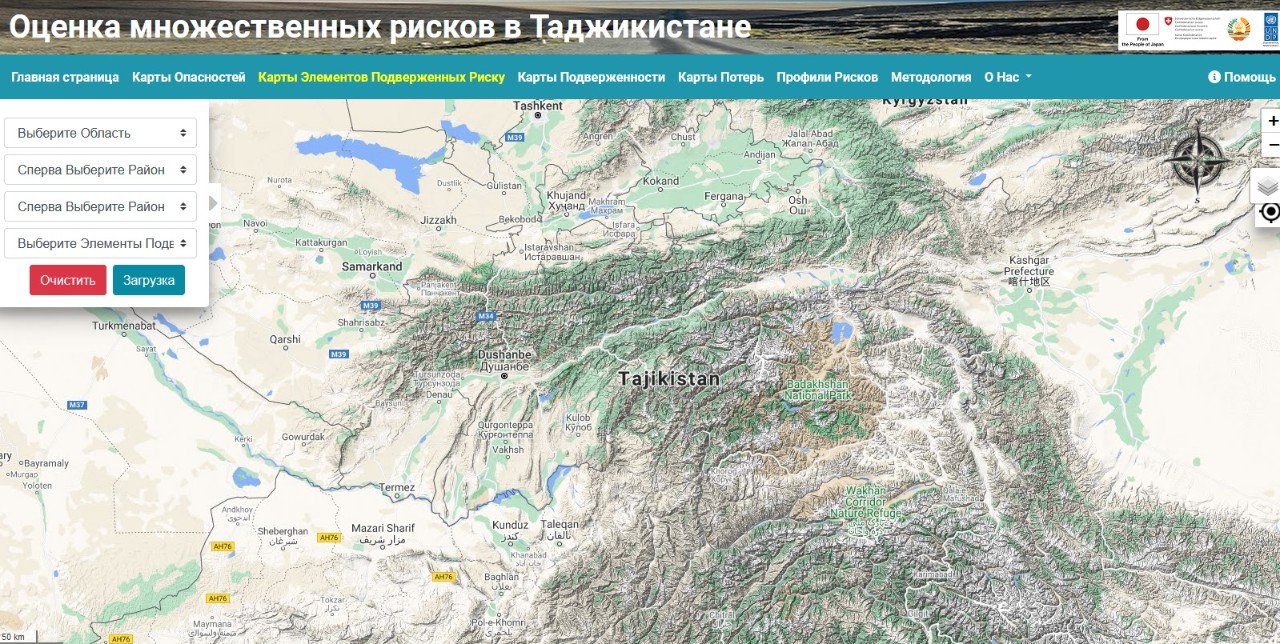
The United Nations Development Program (UNDP) jointly with the Emergencies Committee under the Government of Tajikistan has launched Tajikistan’s first Countrywide Multi-Hazard Risk Assessment Platform.
According to UNDP Tajikistan, the platform is designed to serve as a visual risk analysis tool to facilitate better landscape and developmental planning by stakeholders, risk assessors, decision makers.
“Today only about 20% of District Development Plans in Tajikistan are risk proof in a sense where they effectively incorporate and mainstream disaster risk reduction. The platform is a cornerstone of risk-informed development planning at all levels of governance, and a pathway to ensuring risk prevention and risk mitigation become basic principles in planning process,” Christophoros Politis, UNDP Deputy Resident Representative in Tajikistan said.
The online visual platform is based on data collected for the multi-hazard risk assessment conducted between 2018 and 2020. The team of researchers has aimed to identify vulnerability of communities and infrastructure to natural hazards, and exposure levels to future major hazards prevalent in Tajikistan, including flood, mudflow, earthquake, drought, windstorm, landslide, and snow avalanche.
The assessment covered 58 districts of Tajikistan and seven types of natural hazards most prevalent in the country. The research team conducted feasibility studies using high resolution satellite images and specialized data provided by national agencies, stakeholders, and open-source data.
Output maps have been prepared using the Geographic Information System (GIS), which allows users to see the map layers individually or cascaded one over another to provide users with suited information.
“In the future we plan to use the results of the risk assessment in development of branch programs and plans for socioeconomic development of the regions by taking disaster risk reduction measures best for any district in question” Chairman of the Emergencies Committee Rustam Nazarzoda said.