
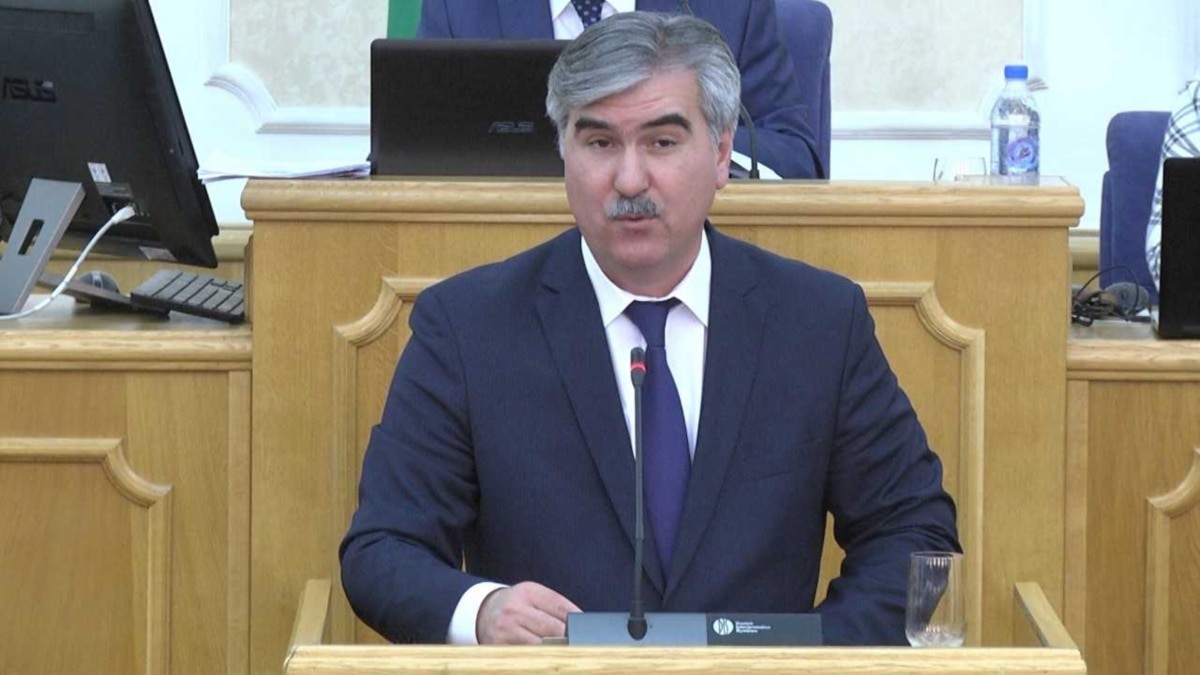
Tajikistan’s lower chamber (Majlisi Namoyadagon) has approved government’s proposal regarding the regulation of debts of Tojiksodirotbonk and Agroinvestbonk that are undergoing liquidation.
It's about repayment of loans provided by the government in early 2017 for recapitalization of these banks.
The Minister of Finance Faiziddin Qahhorozoda has proposed MPs to approve the government’s decision on transferring assets of these two banks undergoing liquidation to the balance of the government with subsequent sale of the.
To secure these loans, the assets of these banks have been pledged, the minister noted.
Recall, TSB and Agroinvestbonk have been experiencing financial problems since the beginning of 2016, and therefore failed to fully meet their obligations to customers.
In 2017, the government provided financial assistance to these banks. Tojiksodirotbonk received a total of 2 billion 250 million somonis, and Agroinvestbonk – 1 billion 70 million somonis.
The bailout process ended up with the government owning 85.9 percent of shares in TSB and an 87.3 percent stake in Agroinvestbonk.
Tajik central bank, however, revoked their operating licenses on May 21, 2021. The regulator said in a statement on May 21 that TSB and Agroinvestbonk have been wound down because restructuring and recapitalization efforts did nothing to improve their financial situation.
The regulator notes that the Individuals Deposits Insurance Fund will refund savings in the amount of up to 30,000 somonis in the national currency and up to 21,000 somonis in the foreign currency.
Meanwhile, the Individuals Deposits Insurance Fund says it had enough reserves to pay insurance compensations to accountholders of these two banks undergoing liquidation.
According to Tajik central bank, the deposits of 23,700 (86 percent) Agroinvestbonk accountholders and 3,500 (64 percent) Tojiksodirotbonk customers will be fully paid back out of the Savings Insurance Fund. Other depositors can expect to receive partial compensation.
The rest of the money owed will be paid once the bank’s assets have been sold off, the regulator said.
TSB was established in December 1990 as the Tajik branch of the Vnesh Econom Bank of the former Soviet Union, and it initially specialized in trade and import-export banking. Later this branch was reorganized into a Joint-Stock Commercial Bank “Tajikvnesheconombank”. In June 1999 the bank was renamed and registered as Tojiksodirotbonk or TSB.
Headquartered in Dushanbe, TSB has 11 branches in the main cities of Tajikistan and covers all regions of the country.
As of May 1, 2018, assets on TSB’s books reportedly include the bank headquarters in Dushanbe, 43 branches across the country, Closed Joint Stock Company (CJSC) Dushanbe Mall (Tajikistan’s largest shopping mall, which is home to the country's first ever hypermarket to be part of the French Auchan chain), Tajikistan Hotel in Dushanbe, eight nine-story apartment buildings in Danghara district (Khatlon province), spinning mills in Danghara and Farkhor districts (Khatlon province), cotton ginneries in Khatlon province, and auto-repair enterprise.
Founded in 1992, Agroinvestbonk, with headquarters in Dushanbe, is now 87.3 percent government-owned as a result of the bailout program. It has main branches in Khorog, Khujand, Kulob and Bokhtar and more than 60 other branches across the republic. In 2012, the government made a decision on recapitalization of Agroinvestbonk and injected 700 million somonis in the bank. 200 million somonis went to replenishing the bank authorized capital stock and 500 million somonis were assigned for the swap.
According to data released by the government, the list of Agroinvestbonk’s assets includes more than 730 objects located in different regions of the country. Among them are the main office of the bank, 60 buildings of its branches, and five service centers. Also, this bank owns recreation areas in the Varzob gorge, various small production facilities, farms, warehouses, gas stations and car services, shopping centers. The list also includes shops, pharmacies, cafes, consumer services centers, numerous apartments and residential buildings.
