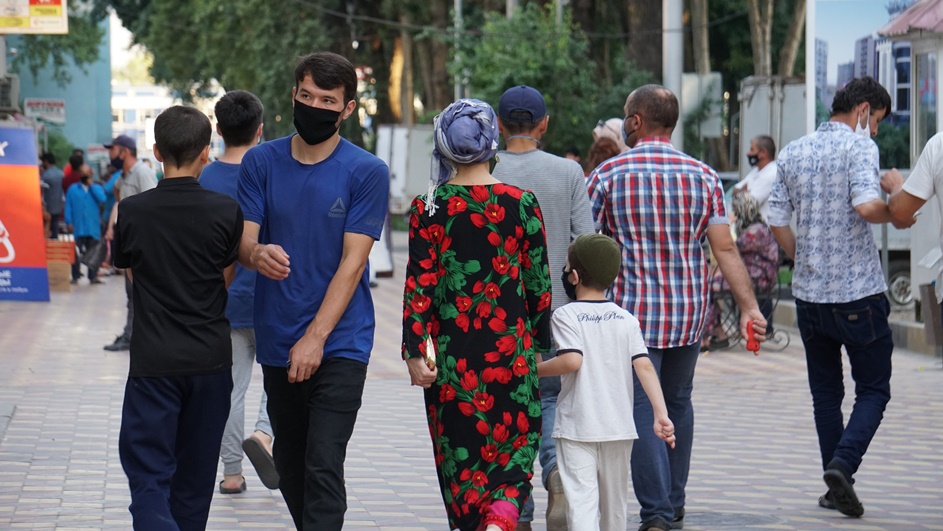
Forty-three new cases of the novel coronavirus (COVID-19) have been officially confirmed in Tajikistan as of the evening of July 13, bringing a total number of COVID-19 cases officially reported in the country since June 21, 2021 to 550.
It is the highest daily number of coronavirus cases officially confirmed in the country since June 21, 2021.
Thus, a total number of the officially confirmed cases of COVID-19 infection in Tajikistan has reached 13,911 since April 30, 2020, when its index cases were confirmed in Dushanbe and Khujand.
According to data from the Ministry of Health and Social Protection of the Population (MoHSPP), twenty-eight COVID-19 patients recovered in the country yesterday.
Thus, the number of those who have been cured in Tajikistan since April 30, 2020 reached 13,581 (99 percent).
A MoHSPP claims that the confirmed number of the coronavirus-linked deaths officially confirmed since April 30, 2020 has not changed since yesterday – 104.
Meanwhile, according to unofficial data, the number of affected persons and coronavirus-linked deaths is in the thousands in the country.
The World Health Organization (WHO) says 15 healthcare workers and 30 participants from the MoHSPP completed 5 days of training on June 29 to develop skills and competencies in providing assistive technology services at primary health care centers in Tajikistan.
The primary purpose of assistive products is to maintain or improve an individual’s functioning and independence and thereby promote their well-being. All assistive products should be provided by trained individuals. Examples include wheelchairs, hearing aids, crutches, shower chairs and spectacles.
WHO/Europe, in collaboration with the MoHSPP, conducted the 5-day training course at the National Orthopedic Center in Dushanbe, using WHO’s Training in Assistive Products (TAP), a free, online interactive learning resource that teaches how to provide assistive products.
The online program consists of training modules organized in 3 stages. The first stage gives a broad overview of what assistive products are and who needs them. The second stage consists of 6 modules on cognition, communication, vision, hearing, self-care and mobility. Individual modules cover key information on assistive products using videos, discussion forums, illustrations and examples.
The training is part of a pilot initiative to test a one-stop assistive technology service provision model, which aims to increase access to a variety of assistive products. The overarching vision of the project is for assistive technology to be embedded within health systems at every level of health care in Tajikistan.