
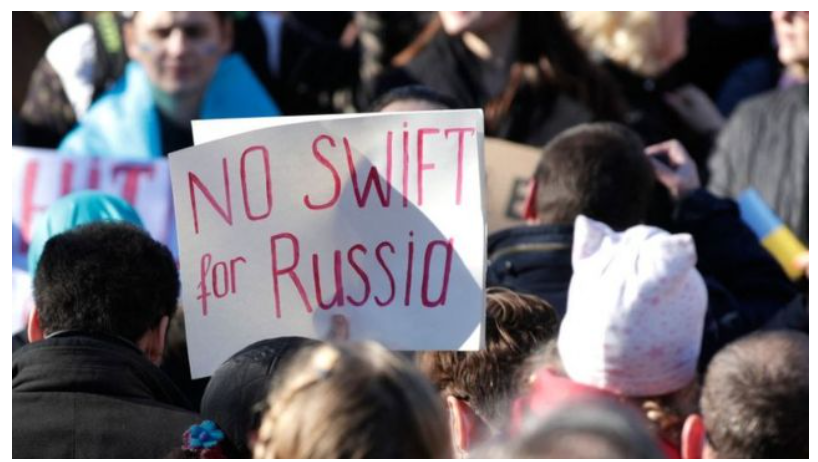
The EU, the United States and their allies have agreed to cut off a number of Russian banks from the main international payment system, Society for Worldwide Interbank Financial Telecommunication (SWIFT).
The assets of Russia's central bank will also be frozen, limiting Russia's ability to access its overseas reserves.
The intention is to "further isolate Russia from the international financial system", a joint statement said.
Russia is reportedly heavily reliant on the Swift system for its key oil and gas exports.
The joint sanctions are the harshest measures imposed to date on Russia over its invasion of Ukraine.
The banks affected were not immediately named. Removal from Swift is deemed to be a severe curb because almost all banks use the system. The measures were agreed by the US, UK, Europe and Canada.
“West decision to cut Russia off from this international payment system used by thousands of financial institutions will create certain difficulties to Tajikistan’s banking network but there will be no catastrophic consequences,” an employee of one of the county’s financial institutions told Asia-Plus in an interview.
According to him, the country’s banks are directly connected to the SWIFT system, while for work with Russian banks that can be cut off from SWIFT there are alternative channels.
“Thus, the System for Transfer of Financial Messages (SPFS) has operated since 2014. This system has been linked to payment systems in Armenia, Belarus, Kazakhstan, Kyrgyzstan as well as Tajikistan,” the banker said, adding that currently there are 331 banks, including Tajikistan’s Tawhidbonk, using the SPFS.
One of heads of Alif Bank, Nouriddin Lafizov, is almost of the same opinion.
“There are several channels of connection with Russian banks, including SPFS and Telex Transfer. Besides, many banks use the Internet-banking system used for communication and mutual settlements. Therefore, there will be no difficulties with mutual settlements and the transfer of financial messages,” Lafizov said.
He also advised not to worry about the money transfer system without opening bank accounts, which ae used by Tajik labor migrants.
“Everything will work, these systems will work because mutual settlements with Russian banks are carried out through alternative channels,” Alif Bank top manager stressed.
“However, problems may arise with the system of correspondent banking relationship, because many banks in Tajikistan use Russian banks as the main correspondents for payments in the dollars and the euros,” said Lafizov. “There will be no problems with money transfers to the CIS nations, most likely there will be problems with money transfers to the United States and European countries. In this case, banks in Tajikistan will have to look for alternative channels.”
Other specialists advise banks to establish direct correspondent relationships with banks in far abroad countries. According to them, certain efforts, money and time (about a month) will be required for this.
SPFS is a Russian equivalent of the SWIFT financial transfer system, developed by the Central Bank of Russia. The system has been in development since 2014, when the United States government threatened to disconnect Russia from the SWIFT system.
Telex Transfer or Telegraphic Transfer, often abbreviated to TT, is a term used to refer to an electronic means of transferring funds. A transfer charge is often charged by the sending bank and in some cases by the receiving bank. Historically telegraphic transfer meant a cable message from one bank to another in order to effect the transfer of money. Prior to the existence of electronic payment networks this was often directly between banks via a telex message.
SWIFT is a secure messaging system that makes fast, cross-border payments possible, enabling international trade. It was created by American and European banks, which did not want a single institution developing their own system and having a monopoly. The network is now jointly-owned by more than 2,000 banks and financial institutions.
SWIFT is overseen by the National Bank of Belgium, in partnership with major central banks around the world – including the US Federal Reserve and the Bank of England.
Based in Belgium, it facilitates transactions between more than 11,000 banks and financial institutions across the globe. It plays a pivotal role in supporting the global economy, but has no authority to make sanction decisions itself.
