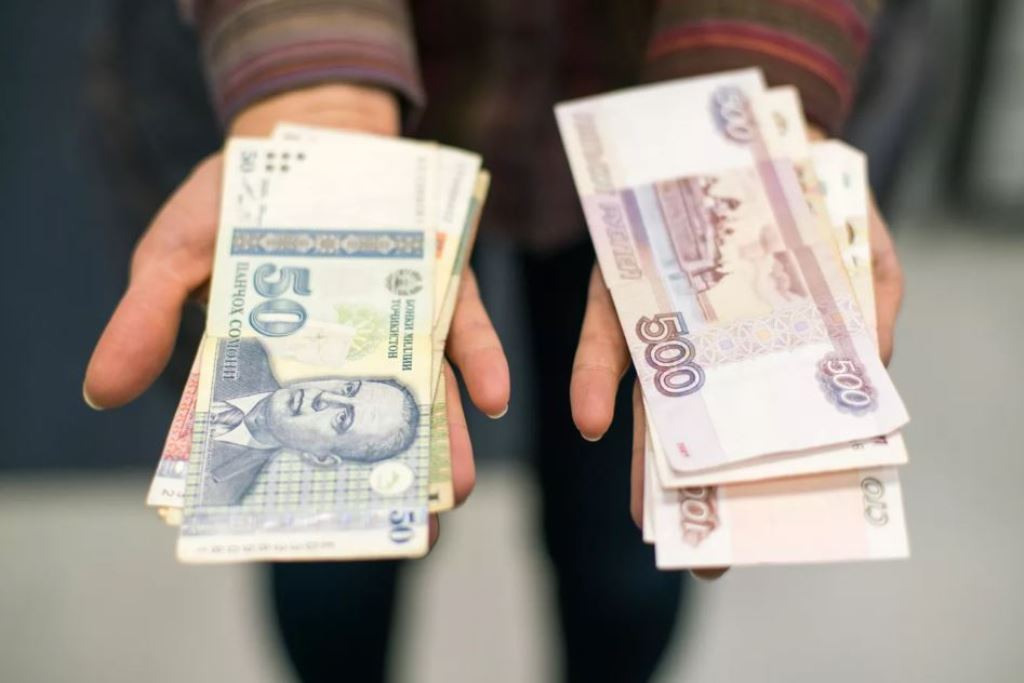
Many users of social media networks and readers of Asia-Plus ask why does the exchange rate of the Russian ruble (RR) of ruble transfers differ from the exchange rate set by commercial banks and why do commercial banks set exchange rates, and this while the National Bank of Tajikistan (NBT) sets official exchange rate every day?
Until 2016, migrants' money entering the country in Russian rubles were exchanged at banks and non-bank exchange offices, but since 2016, the National Bank of Tajikistan instructed commercial banks to issue ruble transfers in the national currency, the somoni, only.
An official source within the country’s financial regulator noted that the official exchange rate set by the NBT is not the buying or selling exchange rate for foreign currency.
“The official exchange rate is set by the NBT every day for the purpose of accounting and calculating customs payments and the financial institutions not required buying or selling foreign currency at the specified rate,” the source said.
He also noted that an exchange rate is the rate at which one currency will be exchanged for another currency.
“The buying and selling exchange rate for foreign currency is set by financial institutions independently depending on supply and demand for foreign currency in the domestic foreign exchange market; therefore, the exchange rates for currency transactions set by financial institutions differ from each other,” the source said.
The official exchange rate of the Russian ruble against the somoni is continuing to increase in the country.
The official exchange rate of RR against TJS set by the NBT increased from 1:0.1725 on May 24 to 1:0.173 on May 26 (0.5-percent increase).
The current grey market buying exchange rate of RR against TJS is 1:0.18 and its current grey market selling exchange rate against TJS is 1:0.183.
The buying rate is the rate at which money dealers will buy foreign currency, and the selling rate is the rate at which they will sell that currency.
Meanwhile, the dollar has lost almost 7.0 percent of its value against the somoni over the past week — the official exchange rate of USD against TJS set by the country’s financial regulator decreased from 1:12.45 on May 20 to 1:11.40 on May 26.
The current grey market buying exchange rate of the dollar against the somoni is 1:11.25
The official exchange rate of the euro against the somoni set by the NBT has also decreased – from 1:12.57 on May 24 to 1:12.21 on May 26 (2.95-percent decrease).
The trend towards an increase in the exchange rate of the somoni against the dollar and the euro has continued since mid-April.