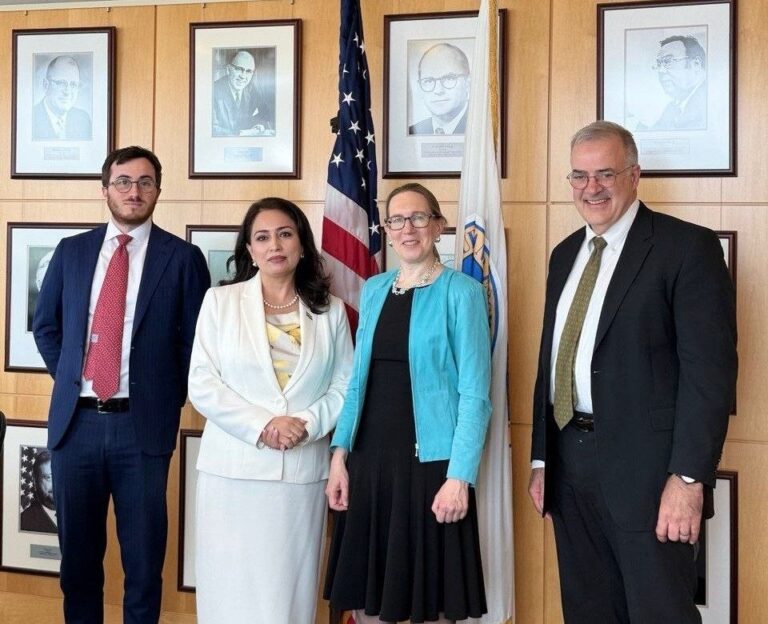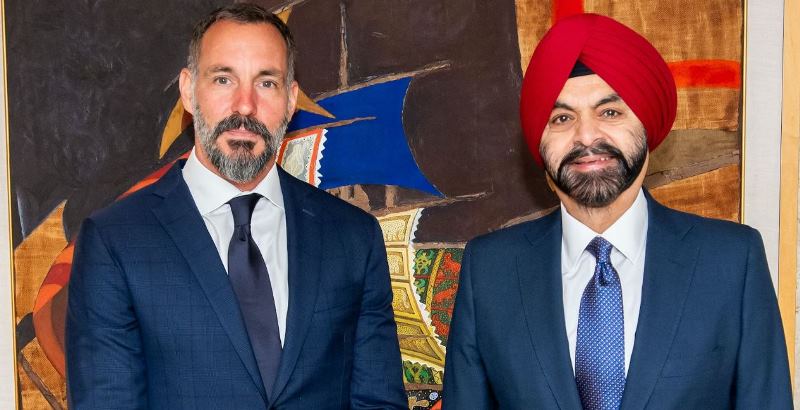
Prince Rahim Aga Khan, the eldest son of His Highness the Aga Khan, the 49th hereditary Imam (spiritual leader) of the Shia Ismaili Muslims and the founder and chairman of the Aga Khan Development Network (AKDN), met the President of the World Bank, Ajay Banga, at the World Bank’s headquarters in Washington, DC, on February 6.
Press release issued by AKDN says they discussed the decades-long development partnership between the World Bank and the various institutions of the Aga Khan Development Network in Africa, South and Central Asia and the Middle East, as well as potential areas of future cooperation, including around climate action, a priority shared by the World Bank and AKDN.
The World Bank and AKDN have reportedly collaborated in the fields of industry, infrastructure, microfinance, clean energy, water supply, health and nutrition, among others. The partnership has extended across most of AKDN’s principal geographies, with particular recent emphasis on collaboration in Afghanistan.
World Bank and AKDN are Tajikistan’s partners for development.
World Bank, international organization affiliated with the United Nations (UN) and designed to finance projects that enhance the economic development of member states.
Tajikistan joined the World Bank in 1993 and the International Development Association (IDA) in 1994. Since then, the World Bank has provided over $2.9 billion in grants and highly concessional credits to support Tajikistan's efforts to reduce poverty and improve people's lives.
AKDN focuses on health, education, culture, rural development, institution building, and economic development. AKDN's mission includes improving living conditions and opportunities for the poor without regard to faith, origin, or gender.
AKDN works for an economically dynamic, politically stable, intellectually vibrant and culturally tolerant Tajikistan. Several AKDN agencies collaborate to bring the government, private sector and civil society together, establish institutions and carry out programs to help with needs as diverse as banking, e-learning and avalanche prevention. It covers all regions of the country and employs more than 3,500 people in health care, education, business, finance and cultural activities.