Almost 4,000 positions in government agencies are currently vacant, and the number of applicants for these jobs has significantly decreased, the Director of the Civil Service Agency under the President of Tajikistan, Juma Davlatov, told reporters in Dushanbe on July 23.
The total number of civil servants is 18,384, including 13,279 men and 4,655 women.
"As of the end of the first quarter of 2024, there were 3,881 vacancies across various ministries and agencies. In the second quarter, 51 vacancies were filled, leaving 3,830 positions still vacant," Davlatov reported.
According to the Agency's data, 12%-13% of positions remain vacant at the republican level, 17%-19% at the local level, and over 30% in jamoats (the third-level administrative divisions, similar to communes or municipalities).
"Holding competitions does not solve this problem. On average, there are 0.5 applicants per vacancy, considering the positions for which no applications have been submitted. In 2023, this figure was 1.4 applicants," Juma Davlatov noted.
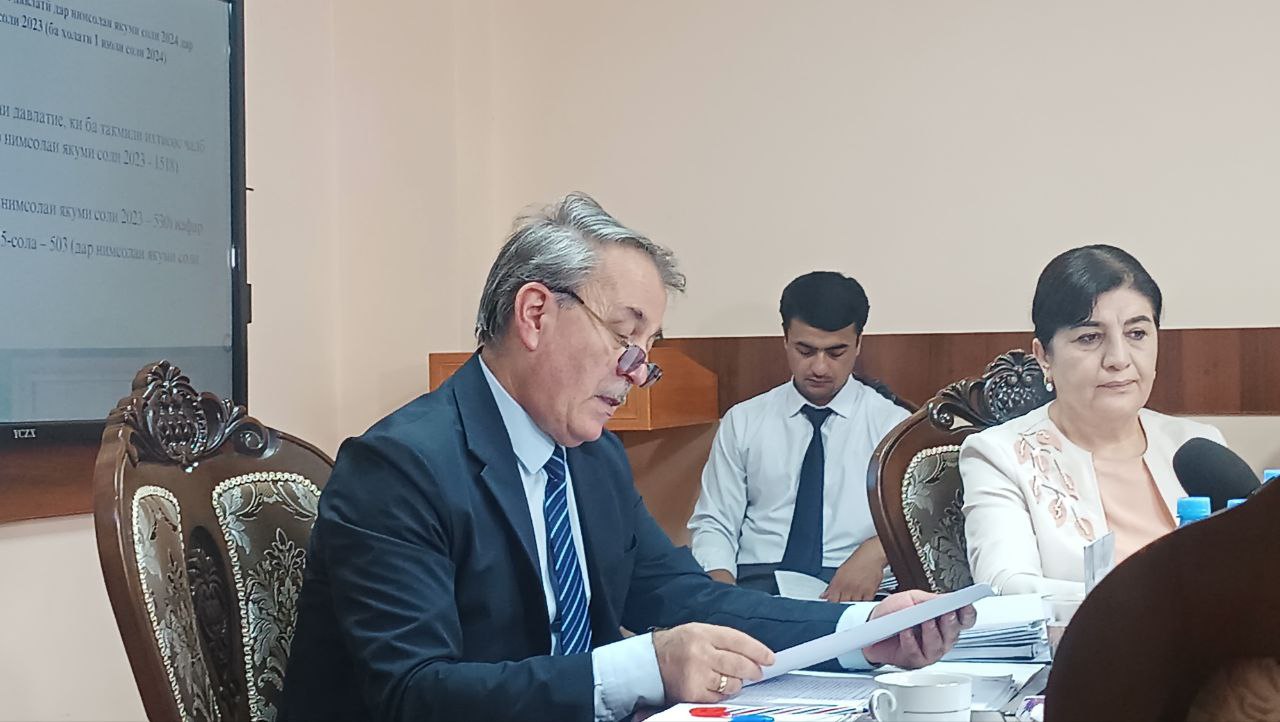
The main reason for the staffing shortage, according to Davlatov, is the high demands and restrictions placed on civil servants. However, he did not specify what these demands and restrictions are, while rejecting low salaries as a reason for the shortage.
"I don't think the shortage is due to salaries. In jamoats, civil servants' salaries range from 1,160 to 2,192 somonis for ordinary specialists, 1,415 to 2,656 somonis for leading specialists, and 1,728 to 3,221 somonis for chief specialists. Higher-ranking officials receive more," he stated.
According to the Agency, as of May 1, the average salary was 1,738 somonis, which would increase to 2,433 somonis with a 40% raise effective July 1.
Few women in civil service
As of July 1, the presidential directive to ensure that women make up 30% of civil service employees has not been met. Davlatov did not explain why this goal has not been achieved.
In response to a question from Asia-Plus about the absence of women among the deputy heads of law enforcement agencies, Davlatov said that similar issues are observed in other departments as well. "Law enforcement and military structures are not within the Agency's jurisdiction. However, this problem also exists in some civil (municipal) bodies, including local self-governance bodies in towns and villages. To address this issue, the agency conducts inspections and on-site consultations, informing the relevant bodies of the results. Additionally, we have other legal powers that we can use if the situation does not improve," he said, without specifying what these measures are and why they have not yet been implemented.
According to statistics, the number of women in civil service has barely increased. In 2014, women made up 23.5% of government employees, and over the past 10 years, this figure has only increased by 2%. Women now constitute 25.3% of all civil servants.
Meanwhile, experts note that Tajikistan lacks a transparent personnel policy for the appointment of civil servants. Tajikistan, like other neighbors in the region, is reportedly a country with a high level of active state intervention in all aspects of public and private life.
Some media often criticize the personnel policy pursued by the Tajik authorities. The criticism states that nepotism, friendly association and personal loyalty are the main criteria in the selection of personnel.