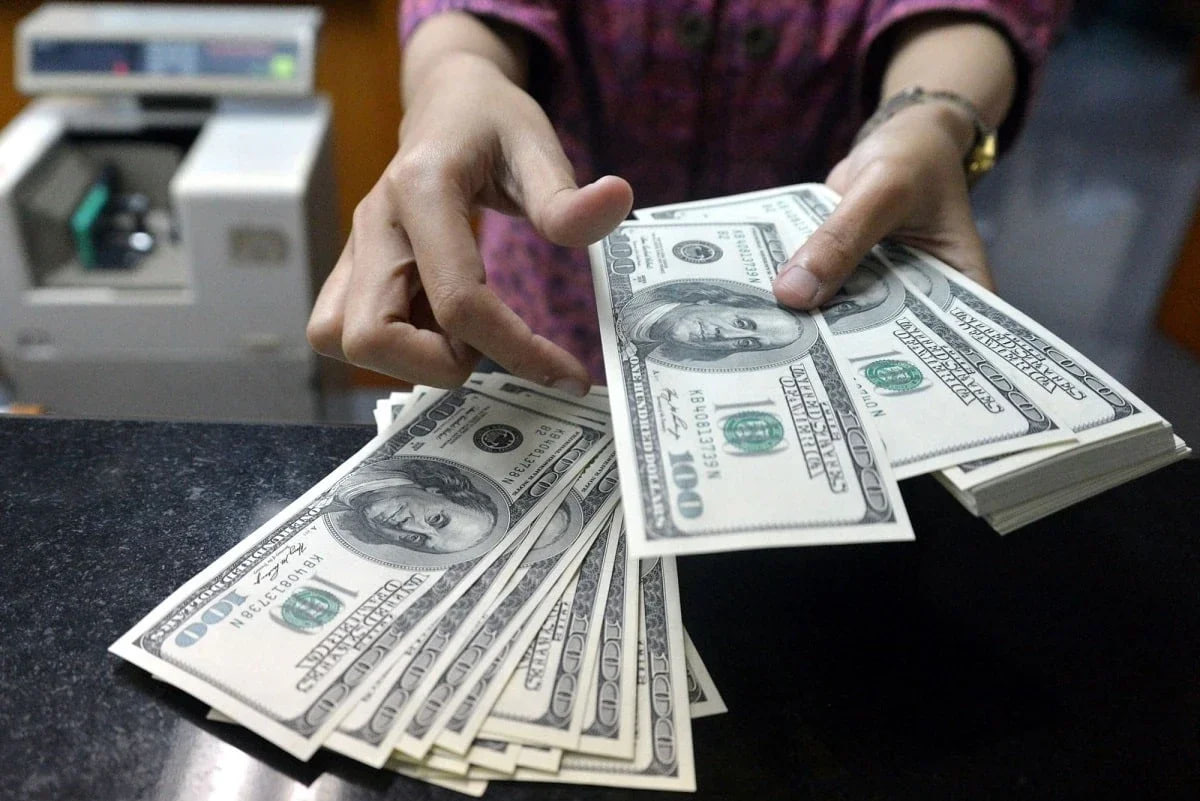
Over the past few months, residents of the republic have been complaining that currency exchange points, for some reason, refuse to accept $100 banknotes issued between 1996 and 2006. These banknotes are popularly referred to as "white dollars" due to their lighter shade.
To verify the existence of this problem, Asia-Plus attempted to exchange such banknotes for somoni at several exchange points but was refused. Employees advised contacting the central office of a bank instead.
The management of the state-owned commercial bank Amonatbank told Asia-Plus that there are no official restrictions on accepting dollar bills. However, not all bank branches are equipped with currency detectors to verify their authenticity.
The bank noted that in recent years, counterfeit $100 banknotes from these years of issuance have appeared in circulation. Therefore, such bills are only accepted at the central office, where the necessary verification equipment is available.
Amonatbank has already accepted "white dollars" worth a total of $730,000, which will later be sent to the U.S.
Commenting on this issue, the head of the National Bank, Firdavs Tolibzoda, told Asia-Plus that the regulator is ready to organize a seamless acceptance system for banknotes that are difficult to exchange.
He confirmed that the problem is due to the lack of proper equipment in some bank branches.
Tolibzoda instructed the responsible employees of the regulator to prepare a video explaining where and how to exchange "problematic" banknotes.
Not Only in Tajikistan
The issue of exchanging "white dollars" is not unique to Tajikistan but is also present in other Central Asian countries.
For example, the Uzbek publication KUN.UZ reported in late January that many countries are gradually ceasing to accept "old" $100 bills, citing social media discussions.
The article noted that the Central Bank of Uzbekistan denied these claims, stating that old $100 bills remain legal tender.
Nevertheless, KUN.UZ emphasized growing public concern. Many customers refuse to accept such banknotes in commercial banks, while sellers of household appliances, electronics, and mobile phones—where prices are often listed in dollars—reluctantly take them, sometimes demanding a discount.
In Kazakhstan, as early as November last year, people began complaining that banks only accepted old dollar bills with a commission fee.
Kyrgyz media reported in early December that difficulties with exchanging dollars issued before 2013 exist in the country.
"They are unofficially refused by exchange offices and commercial banks in Kyrgyzstan, despite the significant volume of such currency in circulation,"
noted an article by Kaktus.media.
Counterfeit Dollars
KUN.UZ also reported that in late November 2024, Turkey launched an investigation into the distribution of counterfeit dollars. Authorities disclosed that $600 million worth of fake banknotes had been smuggled into the country.
As a result, exchange offices and banks temporarily halted transactions involving old-design $50 and $100 bills.
It was reported that the bulk of these counterfeit dollars entered Turkey from Syria, Iran, and the Balkans. The first case involving fake banknotes was recorded in the border city of Gaziantep. Counterfeit bills were also discovered in major tourist hubs such as Antalya, Izmir, Istanbul, and Ankara.
Meanwhile, the Kyrgyz publication Akchabar reported that "white dollars" had "flooded the Central Asian currency market," also claiming that they were allegedly no longer accepted in Russia. However, reputable Russian media refuted this claim.
Old-design dollars are accepted by almost all financial institutions in Russia, with only a few exceptions.