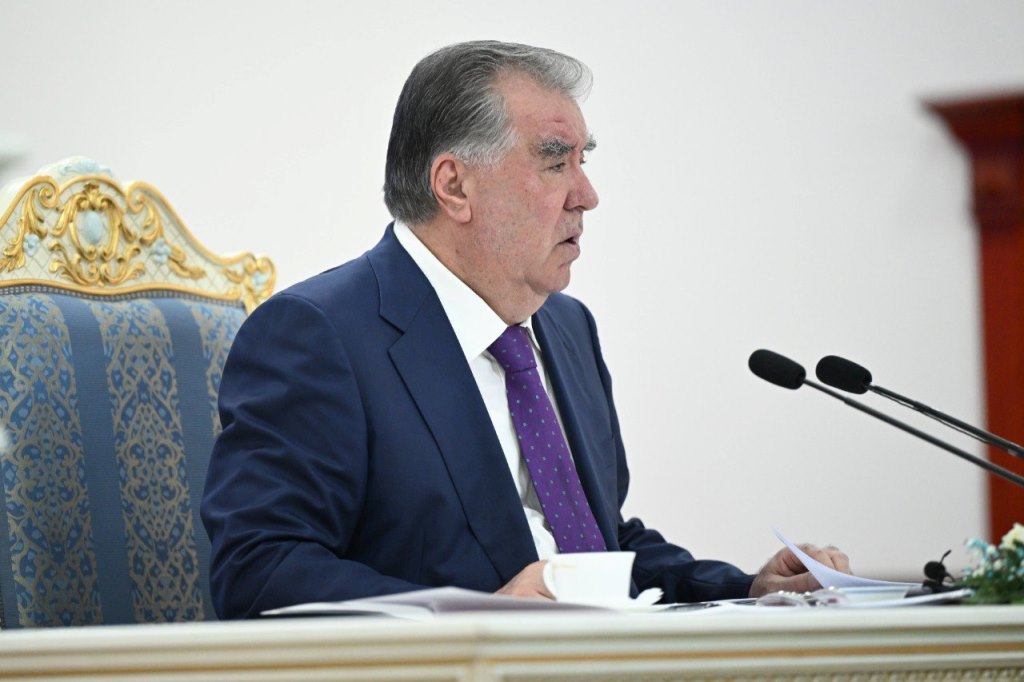
President Emomali Rahmon has urged regional authorities, the Ministry of Finance, and the Tax Committee to step up tax collection efforts and intensify activities aimed at attracting foreign direct investment. The Tajik president’s official website says Emomali Rahmon made these remarks during a seminar-meeting with regional, city, and district leaders of the country in Danghara on May 17.
According to the president, in the first four months of 2025, Tajikistan’s state budget revenues exceeded the plan by 110.6%. However, the tax and fee collection plans were not fulfilled in several areas — Sangvor, Levakant, Yovon, Panjakent, and Ishkashim. As a result, the state budget lost more than 90 million somonis (around US$8.7 million).
“Concrete measures must be taken to ensure timely and full collection of taxes and to reduce tax arrears,” the president emphasized.
Investment growth overshadowed by low direct capital inflow
Between January and April 2025, the economy grew by 8.2%, with inflation at 1.8%. Over this period, Tajikistan attracted 15.4 billion somonis in foreign investment — a 49% increase compared to the same period last year. However, foreign direct investment accounted for just 5.5% of that amount — 812 million somonis.
The situation in Khatlon province was of particular concern: only 27 million somoni were invested, a 63% decrease year-on-year. No direct foreign investments were recorded in the province. A similar trend was observed in other regions as well.
“Government bodies must drastically expand their efforts to attract direct investments to achieve the country’s strategic goals,” Rahmon said.
Industrial output rises as enterprises continue to shut down
Industrial production totaled 18.9 billion somonis during the reporting period — a 25.2% increase. However, the bulk of this growth came from a 1.9-fold increase in the extractive industry. The processing sector grew by only 3.5%.
A sharp decline in textile production — particularly in cotton fiber and fabric output — negatively impacted the manufacturing sector.
Although 121 new industrial enterprises were launched, no new plants or workshops were opened in districts such as Bokhtar, Nurek, Panj, and others. Meanwhile, 159 enterprises across the country ceased operations.
The president tasked the government with creating textile complexes and boosting exports of high value-added products.
Electricity losses remain critically high
In the first quarter of 2025, power losses amounted to 1.3 billion kilowatt-hours — 20.5% of total electricity, up from 20% in 2024. Some districts reported severe losses: Roudaki — 69%, Hisor — 51%, Vakhsh — 36%.
Collection of electricity payments was also below expectations — 83.5% overall and 89.9% among households.
The president reminded officials about newly introduced criminal penalties for illegal electricity use and instructed them to intensify public awareness efforts.
Spring sowing campaign behind schedule
Agricultural output for the period reached 6.9 billion somoni (up 7.7%). However, 56 pumping stations across the country are out of service, leaving over 12,000 hectares of farmland without irrigation.
As of May 12, spring planting had been carried out on 94% of planned areas. Yet, only 73% of the potato crop and 91% of other vegetables had been sown. The availability of potato seeds is at 57%, and cotton seeds — at 73%.
Rahmon demanded urgent action to complete sowing campaigns and increase crop yields.
Honey and silkworm production far below potential
Honey and silkworm cocoon production remain underdeveloped. In 2024, the country produced 4,800 tons of honey, but exported just 2.3 tons. As of April 1, 2025, Tajikistan had 285,000 beehives — a year-on-year increase of just 5.6%.
Cocoon output in 2024 amounted to only 362 tons — a 50% drop from 2014 levels (735 tons).
The president criticized the underperformance of the National Sericulture Development Program and urged authorities to incentivize cocoon production and processing into high-value products.