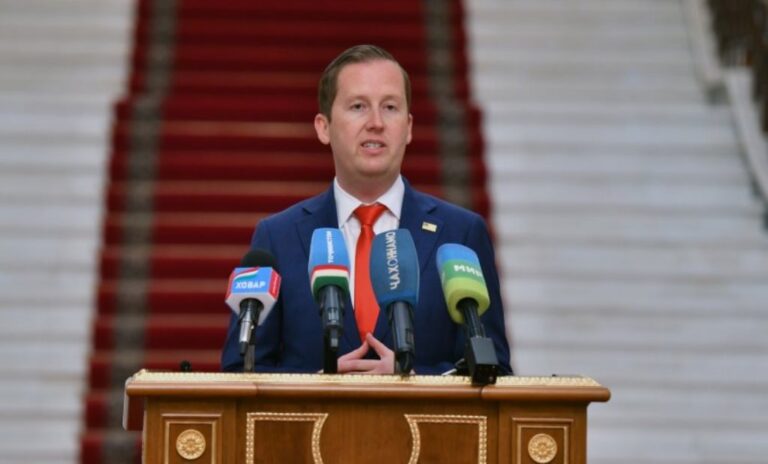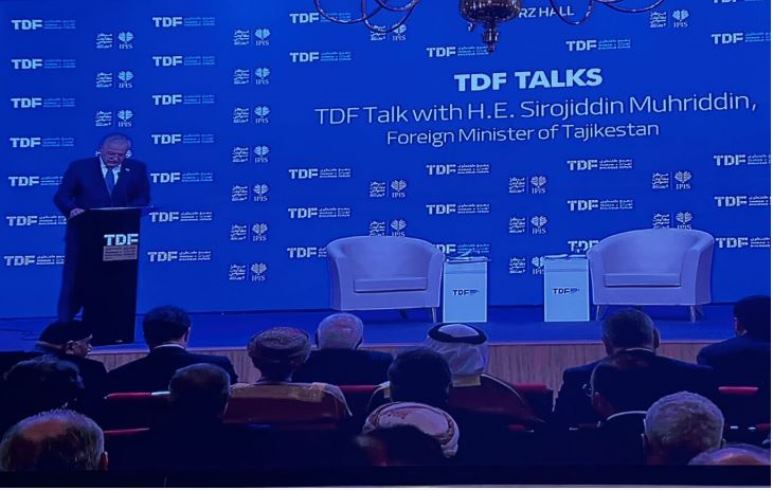
Tajikistan’s Foreign Minister Sirojiddin Muhriddin has called on regional countries to work toward creating a collective security mechanism to promote peace and stability in the region.
IRNA reports that the top Tajik diplomat made the remarks as he addressed the Tehran Dialogue Forum (TDF) on April 18, where he highlighted different problems facing the region.
He reportedly referred to the ongoing humanitarian crisis in the Gaza Strip, noting that Tajikistan strongly condemns the Israeli mass killing of innocent Palestinian people and the destruction of vital infrastructure such as hospitals there.
Calling for an immediate ceasefire and creating corridors to deliver humanitarian aid, the Tajik foreign minister stressed that an independent Palestinian state, with al-Quds as its capital, was the only way to resolve the Israeli-Palestinian conflict.
Elsewhere in his speech, Muhriddin said the water crisis was one of the key geopolitical challenges in the region.
Muhriddin pointed out that, upon a proposal by his country, the United Nations has named 2025 the International Year of Glaciers’ Preservation, and March 21 has been recognized as the World Day for Glaciers, according to IRNA.
The Cradle.co reports that the fourth Tehran Dialogue Forum (TDF) officially kicked off at the Institute for Political and International Studies of the Iranian Foreign Ministry on May 18, bringing together senior officials and diplomats from 53 countries as well as the United Nations.
The two-day event is reportedly aimed at fostering dialogue on pressing global and regional issues.
According to The Cradle.co, this year’s forum is dedicated to the memory of Iran’s late Foreign Minister Hossein Amir-Abdollahian, recognizing his role in shaping Iran’s regional diplomacy. The event reportedly underscores Iran’s aspiration to position itself as a constructive actor in regional and international affairs.
Meanwhile, TDF’s official website reports that at the 2025 TDF’s panel on “Eurasian Cooperation Amid Uncertainty,” regional experts and officials emphasized unity, connectivity, and economic independence as keys to Eurasia’s future.
Mohammed Amersi, Chair of the Amersi Foundation (UK), stressed that the Russia-Ukraine conflict has significantly reshaped Eurasia’s geopolitical landscape. He highlighted the strategic importance of the Zangezur corridor and urged regional states to unite under a shared vision and avoid acting solely on self-interest. “Iran’s position is critical as it borders five countries,” he noted, advocating for the revival of a modern Silk Road and an independent regional financial system.
Farid Shafiyev, Chairman of Azerbaijan’s Center for Analysis of International Relations, emphasized pragmatism in resolving conflicts and saw cross-regional projects, such as the North-South and East-West corridors, as essential. He warned that global crises, including tariff wars and conflicts in Gaza and Syria, affect Eurasia’s stability. Shafiyev also called for respect for cultural commonalities and national sovereignty, noting that peace should be homegrown, not externally imposed.
Sergei Melkonian, research fellow in Armenia's Applied Policy Research Institute (APRI), pointed to trust-building as Eurasia’s biggest challenge. He praised improving ties between Armenia and its neighbors—including Azerbaijan and Iran—and highlighted Armenia’s balanced approach toward both East and West. “We seek no hidden agendas. Dialogue is the only sustainable path,” he said, supporting deeper regional diplomacy, including with Turkiye.
Ali Beman Eghbali Zarch, director of Iran's Eurasian Studies Unit, IPIS, reiterated Tehran’s support for regional connectivity and opposition to any change in international borders. “Iran backs any corridor that fosters cooperation and regional development,” he said, citing the country’s long-standing priority of deepening ties with neighbors.